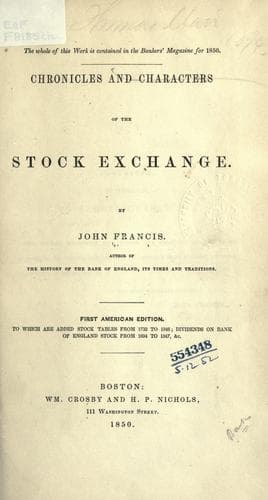
Chronicles and characters of the stock exchangeFrancis, John, of the Bank of England
History
Chronicles and characters of the stock exchange
Francis, John, of the Bank of England
Speculation; Stock Exchange (London, England)
Malplaquet, the glory of which was superior to its results, and the
blood of which was shed to maintain the court influence of the Duke.
But a change of ministry brought a change of measures; and a
Tory government refused to maintain a Whig policy. The ministers
triumphed, and the treaty of Utrecht was concluded. Then arose that
war of words which enlisted the pens of Steele, of Addison, of Swift,
and of a host of other and lesser spirits. The Tories said the
Whigs had sold us to the Dutch, to fill the pockets of Marlborough.
The Whigs said the Tories had sold us to the French, to facilitate
the return of the Pretender. The waste of life, the suspension of
trade, the accumulation of debt, without an adequate return, were so
terribly evident, that the Commons remonstrated, and told her Majesty
that £35,302,107 of the supplies were not accounted for.
It must be evident that every fresh war, every new loan, and every
public peculation, increased the importance of the members of the
Stock Exchange; and when men saw the broker and jobber assuming a
position the public was unwilling to grant, they mistook the effect
for the cause; and a hundred voices were raised, and a hundred
essays written, to prove that the brokers of ’Change Alley were the
bane of the nation. A member could hardly make a financial speech,
a pamphleteer write a political pamphlet, or a dramatist employ his
pen for the public, without dragging in the jobber as an illustration
and a cause of the misery of England. Those who had lost their
money in the many speculations with which the ’Change abounded,
deemed also they had earned a right to decry it. The following is
a specimen of their opinion:—“It is a complete system of knavery,
founded in fraud, born of deceit, and nourished by trick, cheat,
wheedle, forgeries, falsehoods, and all sorts of delusions; coining
false news, whispering imaginary terrors, and preying upon those they
have elevated or depressed.” Archibald Hutcheson, whose life was
afterwards endangered from the determined manner in which he opposed
the South-Sea bubble, says that the jobbers vied with the first
nobility in the kingdom. Pope wrote,—
“Statesmen and patriots ply alike the Stocks,
Peeress and butler share alike the box;
And judges job, and bishops bite the town;
And mighty dukes pack cards for half-a-crown.”
At any rate, it is certain that, if the national glory was
aggrandized, the national debt increased in proportion. From 16
millions to 54 was fearfully felt,—thirty-seven millions and a half
being raised by loan, besides thirty millions in taxes, during the
war of the Spanish succession.
Public-domain text, read in full here on John Shaqi.
Reviews
Reviews
No reviews yet
Be the first to share your thoughts on this work.
Join the Discussion
Join the discussion
Sign in to leave a comment or review.
Sign InorCreate an account