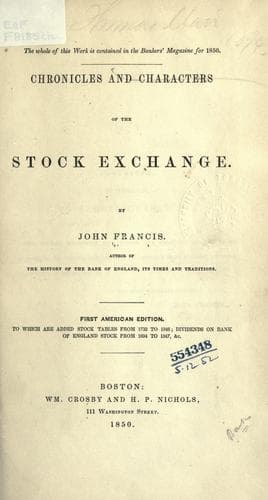
Chronicles and characters of the stock exchangeFrancis, John, of the Bank of England
History
Chronicles and characters of the stock exchange
Francis, John, of the Bank of England
Speculation; Stock Exchange (London, England)
Sir John Blunt was the projector of the South-Sea bubble, which, in
1720, produced such extraordinary effects in England. As the scheme
did not at first prove successful, rumors were spread that Gibraltar
and Port Mahon would be exchanged for Peru. The stock soon rose to
1,000 per cent., and the excitement lasted till September, by which
time it had sunk to 150. Several eminent goldsmiths and bankers were
obliged to abscond; and every family in the kingdom felt the shock.
In other works the anecdotes of this memorable period have been
presented in proportion to their effects upon commerce; in the
present, those only will be given which either affect the Stock
Exchange or possess a general interest.
On May 15th, 1719, the king went abroad, and many who went with him
sold all their funds. The Bank of England was accused of assisting
the bubble by lending money, for the first time, on the security of
its stock; “and this,” said Mr. Aislabie, “furnished an additional
supply of money to gamesters in the Alley.” The stories of the period
are very widely spread, and prove how all ranks were affected. The
Marquis of Chandos embarked £300,000 in it, and the Duke of Newcastle
advised him to sell when he could make the tolerable profit of
cent. per cent. The Marquis was greedy, hoped to make it half a
million, and the advice was declined. The panic came, and the entire
investment went in the shock.
Samuel Chandler, the eminent nonconformist divine, risked his
whole fortune in the bubble, lost it, and was obliged to serve in
a bookseller’s shop for two or three years, while he continued to
discharge his ministerial duty.
The elder Scraggs gave Gay £1,000 stock, and, as the poet had been
a previous purchaser, his gain at one time amounted to £20,000. He
consulted Dr. Arbuthnot, who strongly advised him to sell out. The
bard doubted, hesitated, and lost all. The doctor who gave such
shrewd advice was too irresolute to act on his own opinion, and lost
£2,000; but, with an enviable philosophy, comforted himself by saying
it would be only 2,000 more pairs of stairs to ascend.
Thomas Hudson, a native of Leeds, came to London, and filled the
situation of government clerk. Having been left a large fortune, he
retired to the country, where he lived until, tempted to adventure
in the scheme, he embarked the whole of his fortune in it. After his
loss he came to London, became insane, and Tom of Ten Thousand, as he
called himself, wandered through the public streets, a piteous and
pitiable object of charity.
One tradesman, who had invested his entire resources in the stock,
came to town to dispose of it when it reached 1,000. On his arrival
it had fallen to 900, and as he had decided to sell at 1,000, he
determined to wait. The stock continued to decline, the tradesman
continued to hold, and became, as he deserved, a ruined man.
Public-domain text, read in full here on John Shaqi.
Reviews
Reviews
No reviews yet
Be the first to share your thoughts on this work.
Join the Discussion
Join the discussion
Sign in to leave a comment or review.
Sign InorCreate an account