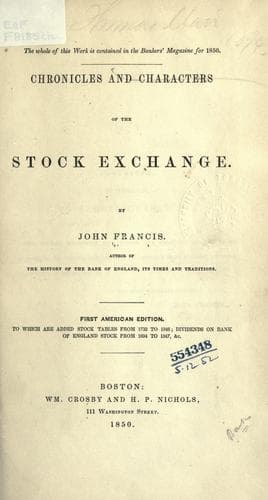
Chronicles and characters of the stock exchange — John Shaqi
Chronicles and characters of the stock exchangeFrancis, John, of the Bank of England
History
Chronicles and characters of the stock exchange
Francis, John, of the Bank of England
Speculation; Stock Exchange (London, England)
A slight sketch of the tyranny and injustice employed by our earlier
monarchs in the production of revenue, may not be unamusing to the
readers of the present volume. The records of the Exchequer prove
that barbaric acts were performed to obtain money; that justice was
openly bought and sold; that the supreme judicature of the country
could only be approached by bribes to the monarch. The county of
Norfolk paid a large sum to Henry I. to secure fair dealing. Yarmouth
paid heavily to prevent a king from violating his own charter.
Commerce was controlled, and trade was harassed. Corporations and
monopolies were created at the monarch’s pleasure; and, as nothing
was too small to escape his notice, so nothing was too large to
escape his grasp. The wife of Hugh de Neville paid two hundred hens
to enjoy the society of her husband twelve hours in prison; and an
abbot paid largely for permission to secure his wood from being
stolen. To mitigate the king’s anger, or obtain the king’s services,
money was equally necessary. When peer and prior were sufficiently
strong to resist, or sufficiently poor to escape, the farmer and the
peasant were visited. The approach of the court was like the approach
of the plague; and men ran to conceal their effects and their persons
until the royal plunderer had passed.
Extraordinary emergencies caused extraordinary expenses; and the
call to arms which resounded throughout Europe when Peter the Hermit
preached deliverance to the captive Sepulchre, was responded to by
Richard I. with the vehemence and energy of his character. To compass
his aim, he mortgaged the customs and he farmed the revenues. He
exacted money from his subjects in proportion to their wealth, and
declared he would sell London itself rather than forego his cherished
object. He feigned the loss of his signet, to procure fees; and, to
crown all, resumed, on his return, the property he had previously
sold, on the pretence that he had no right to alienate it.
King John adopted the notable plan of imprisoning the mistresses of
the priests, confident that the money he could not obtain from their
cupidity he would from their lust. Henry III. seized the merchandise
of his subjects, and borrowed a large sum besides, for which he paid
a high interest, and which the Parliament refused to discharge.
Edward I. seized the money and plate of monasteries and churches,
feigned a voyage to the Holy Land, and, when funds were collected
to aid him, kept the money, and refused to go. Edward III. erected
monopolies, exacted loans, levied arbitrary fines, imposed arbitrary
taxes, and, notwithstanding the determined remonstrances of the
Commons, claimed the right of doing so at pleasure.
Public-domain text, read in full here on John Shaqi.
Reviews
Reviews
No reviews yet
Be the first to share your thoughts on this work.
Join the Discussion
Join the discussion
Sign in to leave a comment or review.
Sign InorCreate an account