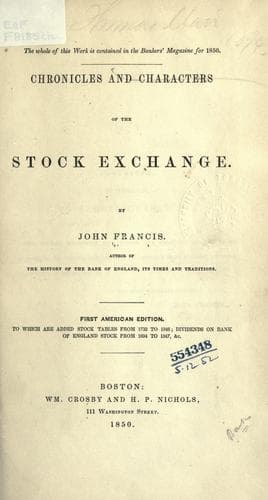
Chronicles and characters of the stock exchangeFrancis, John, of the Bank of England
History
Chronicles and characters of the stock exchange
Francis, John, of the Bank of England
Speculation; Stock Exchange (London, England)
The eagerness of the populace grew with the opportunity. The
newspapers teemed with proposals; and the rage for gambling reigned
uncontrolled. Every ravenous adventurer who could collect a few
articles advertised a lottery. Shopkeepers, compelled by the decrease
of business, took the hint, and disposed of their goods in lottery.
Ordinary business among the lower tradesmen was greatly suspended.
Purchasers refused to give the full price for that which might be
obtained for nothing. Large profits were procured upon worthless
articles; and in 1709, so great was the eagerness to subscribe to
a state lottery, that Mercers’ Hall was literally crowded with
customers, and the clerks were insufficient to record the influx
of names. It was, however, from those which were termed “little
goes,”—which drew the last penny from the pockets of the poor
man,—which saw the father gambling and the daughter starving, the
mother purchasing tickets and the child crying for bread,—that most
evil arose. The magistracy, not always the first to interfere, grew
alarmed, and announced their determination to put in practice the
penalties which, if earlier enforced, would have been beneficial,
but, unhappily, were incompetent to put down that which they might
easily have prevented. It was found, also, impossible to restrain in
private adventurers the wrong that the state sanctioned in public.
It was known that lotteries were injurious to morals and to manners;
it was known that crime followed in their wake; it was known that
misery and misfortune were their attendants; but the knowledge was
vain, and remonstrance useless, under the plea of the necessities of
the state.
Lotteries continued to be employed by ministers as an engine to draw
money from the pockets of the people, at a price alike disgraceful
to the government and demoralizing to all. The extent to which the
evil had reached may be inferred from the fact, that money was lent
on these as on any other marketable security; that, in 1751, upwards
of 30,000 tickets were pawned to the metropolitan bankers; and this,
when, to have an even chance for any prize, a purchaser must have
held seven tickets; and it was ninety-nine to one that, even if a
prize were drawn, it did not exceed £50.
Suicide through lotteries became common. The streets swarmed with
unhappy wretches, who, while they suffered for the past, were making
imaginary combinations for the future. All arts were resorted to.
Lucky numbers were foretold by cunning women, who, when their art
failed, shrouded themselves in their mysticism; and if fortune
favored them, paraded their prophecies to the public.
The most gross and revolting superstition was practised to discover
lucky numbers. Rites which surpassed the darkest imagination of a
Maturin, and ceremonies which appear like relics of the elder world,
were resorted to for the same purpose.
Public-domain text, read in full here on John Shaqi.
Reviews
Reviews
No reviews yet
Be the first to share your thoughts on this work.
Elsewhere in the archive
Join the Discussion
Join the discussion
Sign in to leave a comment or review.
Sign InorCreate an account