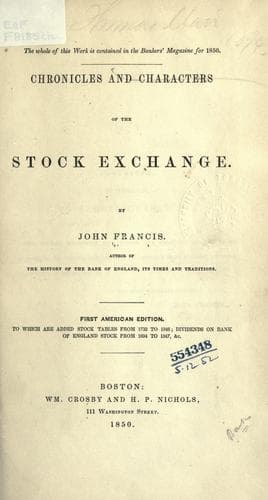
Chronicles and characters of the stock exchangeFrancis, John, of the Bank of England
History
Chronicles and characters of the stock exchange
Francis, John, of the Bank of England
Speculation; Stock Exchange (London, England)
The origin of the blackboard—that moral pillory—of the Stock Exchange
occurred in 1787. “There were no less than twenty-five lame ducks,”
said the _Whitehall Evening Post_, “who waddled out of the Alley.”
Their deficiency was estimated at £250,000; and it was upon this
occasion the above plan was first proposed, and a very full meeting
resolved, that those who did not either pay their deficiencies or
name their principals should be publicly exposed on a blackboard to
be ordered for the occasion. Thus the above deficiencies—larger than
had been previously known—alarmed the gentlemen of ’Change Alley, and
produced that system which is yet regarded with wholesome awe.
During the administration of Mr. Pitt, in 1786, a sinking fund
was again attempted; the various branches of revenue being united
under the title of the Consolidated Fund. One million was annually
taken from it, and placed in the hands of the Commissioners for the
Redemption of the National Debt, and was applied in purchasing such
funds as might be deemed expedient at the prices of the day. The
interest of the debt thus redeemed, the life-annuities which fell in,
or the annuities which expired, were added to the fund, the interest
of which, when the principal amounted to four millions, was no longer
to be applied to it, but remain at the disposal of Parliament.
The difficulties which every minister met in every new loan, were
more in proportion to the power of the opposition, than to the
fairness or necessity of the demand. In unpopular wars, these
difficulties were doubly increased. In the American contest, the
whole population demanded peace; and nothing but the obstinacy of
“the best farmer and worst king,”—nothing but a corrupt Parliament,
wholesale places, a dominant aristocracy, and large premiums to the
moneyed interest,—could have carried Lord North through the session,
enlivened by his humor, and the enmity created by the war. The loans,
therefore, of this period were fiercely attacked; ’Change Alley
fiercely denounced; and the plans of the government hotly contested.
The mode of conducting the loans was then, as before, made conducive
to the majority of the ministry, at the expense of the people. Out
of 60,000 lottery-tickets, 22,000 were given to a few members,
producing £44,000 profit. When the system was attacked, precedent,
the bane of official people, was quoted; and because it was known
that, in 1763, Mr. Fox had £100,000, Mr. Calcraft and Mr. Drummond
£70,000, the Governor of the Bank £150,000 for the corporation, and
£50,000 for himself, and other members similar sums, it was deemed a
sufficient and an unanswerable defence. But though by such methods
the minister got the votes of the House, he found it more difficult
to get the money from the public after it was voted. In 1779, he was
greatly troubled to procure it on reasonable terms. From bankers he
went to contractors, from contractors to stock-jobbers, and from
Public-domain text, read in full here on John Shaqi.
Reviews
Reviews
No reviews yet
Be the first to share your thoughts on this work.
Elsewhere in the archive
Join the Discussion
Join the discussion
Sign in to leave a comment or review.
Sign InorCreate an account