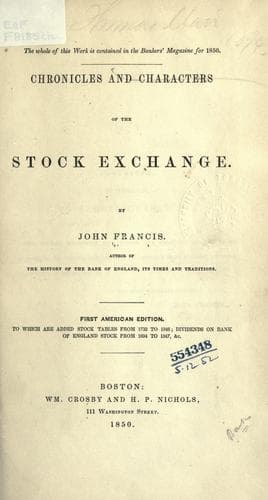
Chronicles and characters of the stock exchangeFrancis, John, of the Bank of England
History
Chronicles and characters of the stock exchange
Francis, John, of the Bank of England
Speculation; Stock Exchange (London, England)
stock-jobbers he went back to the bankers, paying a much higher rate
than they at first demanded. “It was but yesterday,” writes Horace
Walpole, “that Lord North could tell the House he had got the money
on the loan, and is happy to get it under eight per cent.” The loan
of 1780 brought them again into disrepute. Half was given to members
of the House of Commons; more than three millions was allotted to one
person; and, without regard to the welfare of the nation, the price
was determined at a rate so favorable to the contractors, that, from
no cause save the low terms on which it had been taken, the scrip
arose at once to eleven premium. In 1781, it was said that Lord
North had made an infamous bargain in a bungling manner; and that,
in 1782, he had made a bungling bargain in an infamous manner; and
this was solemnly protested against as an improvident operation, a
corrupt job, and a partial distribution. There cannot be a doubt that
the mode of conducting these loans was detrimental to the national
interest, and conducive to that of the Stock Exchange. There were
three plans up to this period. The first was in the offers of private
individuals, stating the sum each would advance; the second was an
open subscription at the treasury; and the third a close subscription
with a few. By the first, the members of Parliament were bribed;
and by the third, the bankers; then the principal contractors were
enriched. Their interest, and it was great, with their votes in the
House, and they were many, were, therefore, at the disposal of the
government. In 1783, out of a loan for £12,000,000, £7,700,000 were
given to bankers. So disgraceful was the whole affair, that Lord
John Cavendish was compelled to apologize for the terms on which it
had been granted, because “the former minister had left the treasury
without a shilling.” By attempting to please men of all parties, Lord
John, as usual, pleased none. He was abused by some for dividing it
among so small a number; he was rated by others for allowing so many
to have a share. Mr. Smith, of the house of Smith & Payne, made a
formal complaint that he had been neglected in the allotment; that
his firm was the only one left out; and that, in consequence, a
stigma of a very disagreeable character was attached to it. By the
explanation, it appeared that another house of the same name had
been accused of tempting customers from the various bankers, by
giving portions of the loan to those who would secede. The meanness
had been attributed to Smith, Payne, & Co., and Lord John omitted
them in consequence from his list. Mr. Smith was very irate on the
subject; and although his Lordship explained, as the explanation
was unaccompanied by a share of the loan, it was, probably, very
unacceptable to the indignant banker. Although this gentleman saw no
harm in receiving a portion of the loan, other bankers had higher
views. Mr. Martin, believing that, as a senator, he ought not to
Public-domain text, read in full here on John Shaqi.
Reviews
Reviews
No reviews yet
Be the first to share your thoughts on this work.
Elsewhere in the archive
Join the Discussion
Join the discussion
Sign in to leave a comment or review.
Sign InorCreate an account