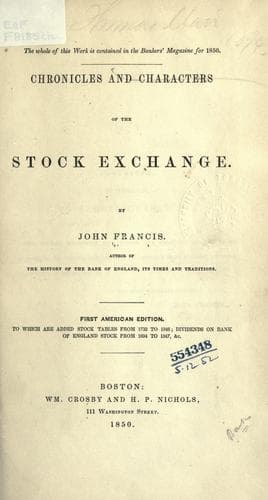
Chronicles and characters of the stock exchangeFrancis, John, of the Bank of England
History
Chronicles and characters of the stock exchange
Francis, John, of the Bank of England
Speculation; Stock Exchange (London, England)
contract, lest it might bias his votes, conscientiously refused to
accept any portion of loan or contract; and thus sacrificed his
pocket to his principle.
When jobbing occurred in the senate, who can wonder at the jobbing
in the funds, or at the strong feeling which such contemptible
squabbling created, and which fell upon the members of the House of
’Change as fiercely as on the members of the House of Commons?
“Such gentry,” said one, “coin disaster to sink the funds without
cause. If gospels mended mankind, there should have been a new
sermon preached on the mount, since ’Change Alley was built, and
money-changers were driven out of the temple all over Europe.” “Ten
thousand lies are propagated every week, not only by both sides, but
by stock-jobbers. Those grave folks, moneyed citizens, contribute
exceedingly to embroil and confound history, which was not very
authentic before they were spawned.”
Lord Chatham was not backward in expressing an opinion of those whom
he designated “the cannibals of ’Change Alley.” “To me, my Lords,” he
once said, “whether they be miserable jobbers of ’Change Alley, or
the lofty Asiatic plunderers of Leadenhall Street, they are equally
detestable.” The same strong feeling animated him when he was told
that one of his measures had caused a decline in the stocks. “When
the funds are falling, we may be sure the credit of the country is
rising.”
A finer spirit—and that spirit is the principle which has pervaded
the whole public transactions of England—was evinced when the same
nobleman was advised to retaliate on the Dutch merchants,—who had
committed several outrageous frauds on the English,—by seizing their
immense property in our funds. “If the Devil himself had money
there,” he replied, “it must rest secure.” To his Lordship, and to
the political assertion he made, that “not a gun should be fired in
Europe without England knowing why,” it was of the utmost importance
that the integrity of the nation should be maintained.
During the American war, many of those in arms had property in the
funds; and the provinces, as bodies corporate, had money in the
same securities. It is to the credit of the revolutionists, that,
though they fully expected this property would be confiscated,
they persisted in their course; and it is equally to the credit of
England, that their capital was as secure, and their interest as
regularly paid, as if they were not in open rebellion.
Public-domain text, read in full here on John Shaqi.
Reviews
Reviews
No reviews yet
Be the first to share your thoughts on this work.
Elsewhere in the archive
Join the Discussion
Join the discussion
Sign in to leave a comment or review.
Sign InorCreate an account