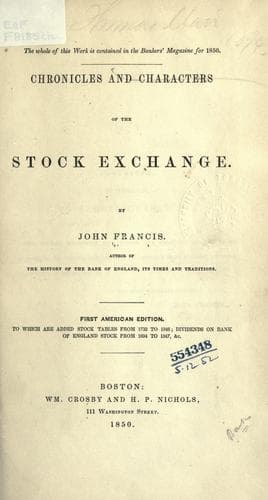
Chronicles and characters of the stock exchangeFrancis, John, of the Bank of England
History
Chronicles and characters of the stock exchange
Francis, John, of the Bank of England
Speculation; Stock Exchange (London, England)
Not only in loans were the people wronged and robbed,—the word is
harsh, but expressive,—the contracts for the public service exhibited
also the most gross and glaring favoritism. From time to time the
evil was exposed; Parliament grew violent, and the public waxed
wroth. Every quarter of a century, an inquiry was instituted, and the
whole ended partly in some influential person being disgraced, and
partly in an expression, that “the said frauds and abuses were one
great occasion of the heavy debt that lies upon the nation.” A few
specimens may serve to indicate the wrongs which, from time to time,
have aggrandized an unpopular government, have swollen the pockets of
the few, and increased the wants of the many.
The borough-monger, who for years had been in possession of a pocket
borough, found his property disturbed, and his constituents tampered
with, by the contractor, who, as a candidate for the honor of the
forum, was marked by vice, extravagance, and folly. As a member of
the senate, he assumed the purity of the patriot, complained of
the absence of economy, and declared how much cheaper the public
business might be accomplished. He teased the minister; he perplexed
the Parliament; he puzzled the government; until, by giving him a
job, the patriot was turned into a contractor, and from that hour he
marked the public money as his own. If the First Lord of the Treasury
were indolent, the contractor availed himself of his sloth; if
ignorant, he taught him, and made the country pay for the lesson.
The very name of a contractor was odious, and their luxuries were
bitter in the eyes of the people. Their abodes were like those of
princes; their daughters wedded with nobles; the follies of their
sons were the talk of the town; they died possessed of fortunes which
kings might envy; and, as nearly all were members of Parliament,
attention became pointed at men whose mansions and whose manors,
bought with public money, challenged public notice.
“The minister,” remarked Mr. Fox, “said to him, ‘I will give you a
contract, if you will give me a vote.’ The contractor replies, ‘Now
I have given you a vote, give me a contract. I voted that we had
forty-two ships when we had but six, and that the French fleet did
not consist of thirty-two ships. You must not, therefore, quarrel for
twopence a gallon on rum, or a farthing on a loaf of bread.’”
Public-domain text, read in full here on John Shaqi.
Reviews
Reviews
No reviews yet
Be the first to share your thoughts on this work.
Elsewhere in the archive
Join the Discussion
Join the discussion
Sign in to leave a comment or review.
Sign InorCreate an account