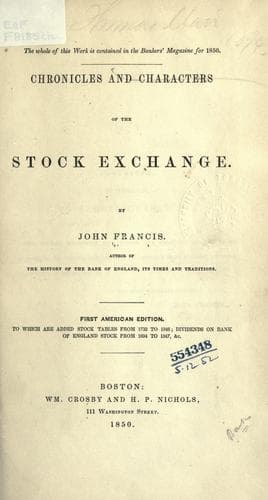
Chronicles and characters of the stock exchangeFrancis, John, of the Bank of England
History
Chronicles and characters of the stock exchange
Francis, John, of the Bank of England
Speculation; Stock Exchange (London, England)
Lord George Gordon, shortly before his extraordinary conduct in 1780,
said,—“This dunghill of contracts has given an ill air to our whole
proceedings. It has got abroad, and proves very offensive to the
public nostrils. Our constituents begin to smell a rat. They nose
us in the lobby, and call us tailors and shoemakers, cobblers and
cabbage-salters, potato forestallers, sour-krout makers, and swine
contractors. The dignity, reputation, and fair fame of the Commoners
is smothered and sinking in porter and salted cabbage, shoes,
sour-krout, and potatoes.” Lords of trade ordered pewter inkstands
by the hundred, sold them, and purchased silver ones with the money
they produced; or ordered green velvet bags for official papers, and
employed the velvet of which they were composed to make court dresses.
Under the Pelham administration, members received regular stipends
in bank-notes, from £500 to £800 yearly, varying according to the
influence or ability of the senator. “This largess I distributed,”
added the person who took charge of the delicate department,—and
the particulars are worth enumerating,—“in the court of requests
on the day of the prorogation of Parliament. I took my stand there;
and as the gentlemen passed me, in going to or returning from the
House, I conveyed the money in a squeeze of the hand. Whatever
person received the ministerial bounty, I entered his name in a book
which was preserved in the deepest secrecy, it being never inspected
by any one but the king and Mr. Pelham.” This book was afterwards
demanded of Mr. Roberts, the almoner, but he resolutely refused to
yield it except by the king’s express command, or to his Majesty in
person. In consequence of his refusal, the king sent for him to St.
James’s, where he was introduced into the closet. He was then ordered
to return the book in question, with which injunction Mr. Roberts
immediately complied. At the same time, taking the poker in his hand,
his Majesty put it into the fire, made it red hot, and, while the
ministers and Mr. Roberts stood round him, he thrust the book into
the flames, where it was immediately reduced to ashes.
These evils were so manifest and manifold, that, after various
attempts to pass a measure which should be some check on government,
a bill was introduced, by which all contracts were made subject to a
species of auction, although the minister was not compelled to accept
the lowest offer.
Public-domain text, read in full here on John Shaqi.
Reviews
Reviews
No reviews yet
Be the first to share your thoughts on this work.
Elsewhere in the archive
Join the Discussion
Join the discussion
Sign in to leave a comment or review.
Sign InorCreate an account