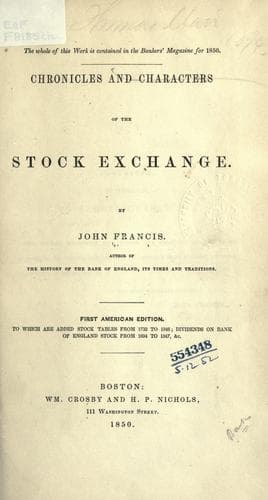
Chronicles and characters of the stock exchangeFrancis, John, of the Bank of England
History
Chronicles and characters of the stock exchange
Francis, John, of the Bank of England
Speculation; Stock Exchange (London, England)
During the debates which were held upon the subject, many other facts
were elicited, which confirm all the previous remarks, and prove
the iniquity with which the money of the country was disposed of.
One member possessed a contract producing £30,000 a year more than
the legitimate profit. Mr. Alderman Harley made £37,000 too much by
another. On a contract for remitting gold, £35,000 was paid more than
was necessary. At an earlier period it was discovered, that, out of
16,000 tuns of beer contracted and paid for, only 7,000 tuns were
delivered. The rum contract was granted at fifty per cent. above
a remunerating price. The transport service paid twenty per cent.
too much. Millions were lying for years in the hands of favorite
placemen, favorite agents, and favorite contractors, while the
country was borrowing at an exorbitant interest; and, after a careful
perusal of the evidence, there can be no doubt that the charge of
corrupting the House was true; nor was it in the nature of a member
of Parliament in the eighteenth, any more than in the nineteenth
century, to possess profitable contracts, the continuation of which
depended on war, and yet speak honestly and earnestly for peace.
The names of Abraham and Benjamin Goldsmid will recall to the memory
of many of our readers the forms and features of these magnates of
the money-market. Of singular capacity, and of equally singular
good fortune, the firm of which they were the members rose, from
comparative obscurity, to be the head and front of ’Change Alley.
Prior to 1792 they were little known,—Mr. Gurney, the eminent
bill-broker, regards them as his predecessors,—but by that year they
occupied an important position, and became successful competitors for
the national loans. They were the first members of the Stock Exchange
who competed with the bankers for the favors of the Chancellor,
and diverted from their purses those profits which were scarcely
a legitimate portion of banking business. The combination of that
interest being thus broken, the bargains for public loans became
more open; there was no confederation to limit and lower the prices;
and the ministry and country reaped the benefit in improved terms.
The house of Sir William Curtis, whose fortunes were founded in
this manner; of Dorrien and of Boldero, names which, great in their
day, have almost passed from the roll of city bankers; of Grote,
now better known as the philosophical historian of Greece; were
all competitors, three quarters of a century ago, for those loans
which the necessities of the country made so frequent. Nor were
people wanting who openly accused the entire banking interest of an
unfair confederation to realize their views. This interest was first
attacked by the boldness of Abraham and Benjamin Goldsmid; and it is
easy to imagine the feelings of the bankers when unknown men reaped
the prize which they had hitherto gathered.
Public-domain text, read in full here on John Shaqi.
Reviews
Reviews
No reviews yet
Be the first to share your thoughts on this work.
Elsewhere in the archive
Join the Discussion
Join the discussion
Sign in to leave a comment or review.
Sign InorCreate an account