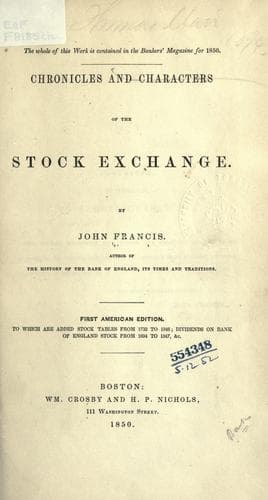
Chronicles and characters of the stock exchangeFrancis, John, of the Bank of England
History
Chronicles and characters of the stock exchange
Francis, John, of the Bank of England
Speculation; Stock Exchange (London, England)
The daily papers bore an almost daily testimony to their munificence.
Naturally open-handed, the poor of all creeds found kindly
benefactors. On one day, the grandeur of an entertainment to royalty
was recorded; and on the next, a few words related a visit of mercy
to a condemned cell. At one time, mansions, vieing in architectural
beauty with those of our nobility, were described; at another, some
great and gracious act of charity was recorded. Entertainments
to princes and ambassadors, reviving the glories of the Arabian
Nights, were frequent; and galleries, with works of art worthy the
magnificence of a Medici, graced their homes. They were awhile
Fortune’s chief and most especial favorites. When, in 1793, the old
aristocracy of England’s traders fell, as in 1847, and the Bank in
one day discounted £4,400,000, their losses amounted but to £50.
Prizes, under circumstances little inferior to romance, followed
their purchases of lottery-tickets; and they knew, as if by instinct,
a bill of exchange with a bad name to it.
The brothers had faced the storm of life in their earlier years.
Fortune, which crowned their efforts, proved that prosperity had no
power to divide them; and when, in the early part of the nineteenth
century, Benjamin Goldsmid destroyed himself, the survivor felt the
loss so severely, that he never recovered the shock. The death of
Benjamin caused no abatement in the benevolence of Abraham Goldsmid;
and one who knew him well has written with enthusiasm of his “general
philanthropy, his ready munificence, his friendly demeanour, his mild
and unassuming manner.”
Many anecdotes, singularly illustrative of his kindly feeling, are
still remembered. It is stated that, on one occasion, noticing a
great depression in the waiter who usually attended him where he
dined, he inquired the cause, ascertained that it was pecuniary,
gave the astonished man double the amount he required, and refused
to listen to the thanks of the recipient. Another story is extant
to the same purport. He became acquainted by accident with one of
those simple and single-minded country curates, whose poverty was the
disgrace, and whose piety was the glory, of the Church of England.
This was the man for Abraham Goldsmid at once to appreciate and
to benefit. He obtained all the necessary particulars, and in a
few weeks a letter was received, which told the curate he had been
allotted a share of a new loan. The letter was a mystery to the
country clergyman, who placed it on one side, with a confused notion
that a hoax was intended. He had not long to wait. The next day
brought a second letter, and with it comfort and consolation, in the
shape of a large sum which had been realized on the allotment. These
things are pleasant to record; and it is doubtful whether the check
gave most pleasure to the wealthy Hebrew to write, or the country
curate to receive.
Public-domain text, read in full here on John Shaqi.
Reviews
Reviews
No reviews yet
Be the first to share your thoughts on this work.
Elsewhere in the archive
Join the Discussion
Join the discussion
Sign in to leave a comment or review.
Sign InorCreate an account