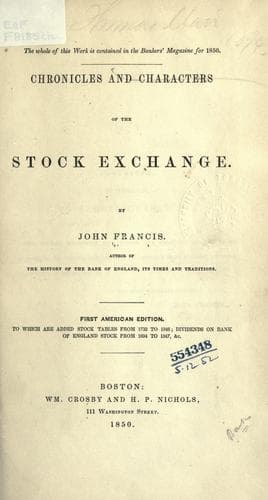
Chronicles and characters of the stock exchangeFrancis, John, of the Bank of England
History
Chronicles and characters of the stock exchange
Francis, John, of the Bank of England
Speculation; Stock Exchange (London, England)
To the English sovereign a certain power over commerce had always
been intrusted; but Elizabeth stretched her prerogative, and granted
monopolies by scores. Prices rose enormously, and the evil was felt
by every family in the realm. The House of Commons remonstrated. When
a long list of patents for monopolies was read, one sturdy member
demanded, “Is not bread there?” “Bread!” quoth one. “Bread!” cried
another. “Yea, bread!” said Mr. Hackwell; “for, if care be not taken,
bread will be there before next Parliament.” Nor was this all: the
coach of the chief minister was surrounded by the populace; menacing
murmurs were heard cursing patents; and indignant voices declared
that the old liberties of England should not be encroached on by new
prerogatives. With admirable sagacity, the queen saw the necessity
of yielding, and did it while she could with grace and dignity. But
this sovereign improved upon the plans of her predecessors,—she
kept the temporalities of bishoprics in her own hands for years,
and appropriated the landed property of sees. Under the name of New
Year’s gifts, she extorted large sums from the frequenters of the
court; she ordered companies to lend her money,—to borrow, if they
did not possess it,—and, if she had more than she required, she would
return part, provided they would pay her interest for that on which
she paid them nothing. To the citizen of the nineteenth century
this must appear a fable; but it is a recorded fact, that Elizabeth
borrowed money from the citizens, found she had more than she
required, and, instead of repaying it, re-lent it to them at seven
per cent. on the security of gold and silver plate.
Charles I. seized the money of his merchants; and his bonds were
hawked about the streets, were offered to the people as they left
church, and sold to the highest bidder. The Commonwealth were
debtors, on the security of the forfeited estates. Charles II. took
money from France, shut up the Exchequer, borrowed from his friends,
and did any thing rather than run the risk of being again sent on
his travels. Thus, it would seem, the exchequer of the earlier
monarchs was in the pockets of the people; that of Henry VIII. in the
suppressed monasteries; Elizabeth in the corporations; and Charles
II. wherever he could find it.
Public-domain text, read in full here on John Shaqi.
Reviews
Reviews
No reviews yet
Be the first to share your thoughts on this work.
Join the Discussion
Join the discussion
Sign in to leave a comment or review.
Sign InorCreate an account