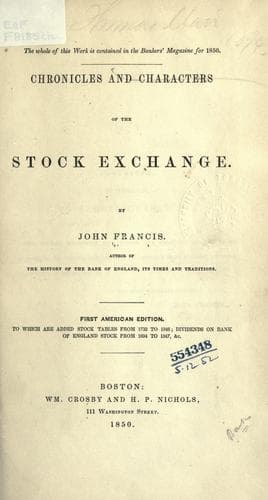
Chronicles and characters of the stock exchangeFrancis, John, of the Bank of England
History
Chronicles and characters of the stock exchange
Francis, John, of the Bank of England
Speculation; Stock Exchange (London, England)
The charge of employing official information to speculate in the
funds has often been brought against public men. These accusations
have often been made with cause, but generally with caution. In
August, 1805, however, a letter was received by the head of the
government, signed by Ambrose Charles, a clerk in the employment of
the directors of the Bank of England, in which Lord Moira, a cabinet
minister, was accused of availing himself of his official information
to speculate in the stocks. The name of the broker employed by his
Lordship was given; and letters which implicated him were said to
have been publicly exhibited on ’Change. The underlings of newspapers
were declared to be in communication with the accused nobleman; and
the document concluded with the offer of proving these assertions,
should Lord Grenville require further information.
The letter was too important to be overlooked; and the prime
minister gave the required interview to the writer, who, persisting
in his assertion, calmly and confidently declared its truth; and
was proceeding with his story, when, with a dramatic effect rarely
witnessed off the stage, the door of an adjoining apartment was
opened, and the accused confronted his accuser. There appears to be
no other evidence of what passed at this interview than that given
by Ambrose Charles, which, being entirely favorable to himself,
cannot be trusted. No proof was tendered of the assertion; but the
morning on which the letter had been sent, the writer remarked to a
fellow-clerk, “I have done a deed which will immortalize me.” The
subject was made a matter of legal inquiry; affidavits from all who
had been named as having inculpated his Lordship evinced his complete
innocence, and the entire evidence proved the falsehood and folly of
the criminator. The charge was eventually dismissed as untenable; and
the whole affair can only be regarded as one of those morbid cravings
after notoriety which arise equally from a diseased brain and an idle
vanity.
In 1807 and 1808, a general and feverish love of speculation was
abroad. Joint-stock companies were the feature of the day; canals,
bridges, and life assurance being the great favorites, which, if
injurious to the speculator, were beneficial to the country. To this
period London owes Waterloo and Vauxhall bridges, with many more
of those public works forming to the foreigner objects of so much
interest.
Public-domain text, read in full here on John Shaqi.
Reviews
Reviews
No reviews yet
Be the first to share your thoughts on this work.
Elsewhere in the archive
Join the Discussion
Join the discussion
Sign in to leave a comment or review.
Sign InorCreate an account