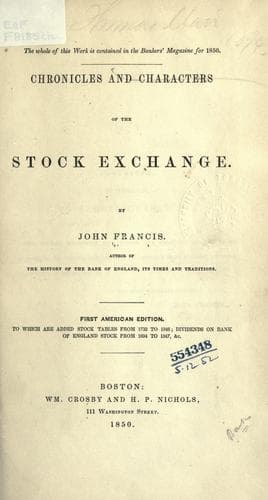
Chronicles and characters of the stock exchangeFrancis, John, of the Bank of England
History
Chronicles and characters of the stock exchange
Francis, John, of the Bank of England
Speculation; Stock Exchange (London, England)
One of the greatest capitalists of the reign of George III. died in
1808. Mark Sprot, a name which will recall many a pleasant anecdote
to members of the Stock Exchange, born a younger brother, with a
younger brother’s portion, achieved, by his own exertions, one of
those fortunes which arose out of the loans of the French war. In
1780 he settled in London, with moderate means; and, from occasional
visits to the Bank and Stock Exchange, formed an intimacy with the
members of the moneyed interest. He soon saw that, with small risk,
he might make great gain, and commenced a career which ended in
splendid success. In 1799, he was one of the contractors for the
lottery; and, in 1800 and the three following years, he was at the
head of those who bid for the loans.
During the trial of Lord Melville, Mark Sprot was examined, in
consequence of having borrowed money from Mr. Trotter. The latter, on
a comparatively trifling income, had built a splendid mansion; and as
attention had been drawn to the circumstance, Mr. Sprot’s name was
involved. When examined by the committee, and asked whether he did
not act as banker to members of both Houses, “I never do business
with privileged persons,” was the shrewd, but daring reply. This
answer originated, probably, from the following anecdote.
On one occasion a broker applied to Mr. Sprot, and with great sorrow
told him that he was a ruined man. Mr. Sprot was surprised, for
he knew the speaker was careful, industrious, and not likely to
speculate. He asked the cause, and the broker replied, that he had
been employed largely by a principal, who, the prices having gone
against him, had refused to pay his losses. Mr. Sprot immediately
inquired his name; and on being told it was a noble earl, of whose
resources he was well aware, could scarcely believe he heard
correctly.
He knew him to be in possession of large landed estates; and, when
informed that his Lordship had refused to give any reason except
that it was not convenient, Mr. Sprot told his visitor not to be
alarmed, that he would not press his claim, and concluded by making
an engagement with him to visit his Lordship.
Together they went, and were received with patrician dignity. Mr.
Sprot deliberately detailed his business, and received the cool
reply, that it was not convenient to pay. But the energetic jobber
was not a man to bow before rank, unless accompanied by worth; and
Mr. Sprot unhesitatingly declared, that, if the account were not
settled by a certain hour next day, he would post his Lordship as a
defaulter. The latter grew alarmed, and attempted to conciliate; but
the conference closed with the repeated determination of Mr. Sprot
to post him. Long before the hour appointed, however, his Lordship’s
solicitor waited on the broker to arrange the payment; and thus the
honor of the earl was preserved, and the credit of the broker saved
in the money-market, through the acuteness and determination of Mark
Sprot.
Public-domain text, read in full here on John Shaqi.
Reviews
Reviews
No reviews yet
Be the first to share your thoughts on this work.
Elsewhere in the archive
Join the Discussion
Join the discussion
Sign in to leave a comment or review.
Sign InorCreate an account