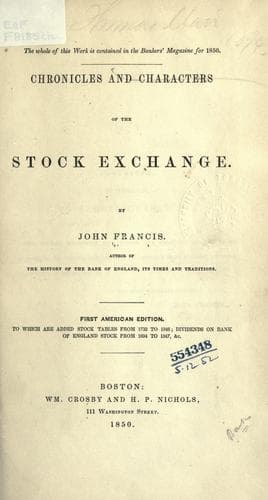
Chronicles and characters of the stock exchangeFrancis, John, of the Bank of England
History
Chronicles and characters of the stock exchange
Francis, John, of the Bank of England
Speculation; Stock Exchange (London, England)
In 1810, an application was made to Parliament for permission to
erect and secure to the public the right of admission to an open
market for the sale and purchase of national securities, on the
ground that the public ought not to be excluded from the room in
which business in the public funds is contracted. The bill was
introduced by Sir William Curtis, and rejected by the senate.
The history of the house of Baring—which, though generally regarded
as mercantile, is largely connected with the loans—has been termed an
evidence of the power of a few active young men to advance themselves
to immense fortune, and to distinguished marks of favor from the
sovereign. Various origins are attributed to the members of the firm,
and the Herald’s College has been employed to give the dignity of
ancestral honors to the family. In 1793, the first baronet of the
name was created, and the signal services of Sir Francis to the East
India Company, of which he was a director, were greatly appreciated.
It has been stated,—but as the writer is uncertain of his authority,
he gives it with caution,—that they were originally German weavers,
who came over to London, and, being successful in business, were,
through the interest of William Bingham, of Philadelphia, appointed
agents to the American government. Considering, therefore, the
large resources at their command, it is not surprising that, during
the loyalty loan in 1797, the head of the house made one hundred
thousand pounds for three consecutive days; or that, in 1806, it was
sarcastically said, “Sir Francis Baring is extending his purchases so
largely in Hampshire, that he soon expects to be able to inclose the
country with his own park paling.”
In 1805 this gentleman, the first algebraist of the day, retired from
business with a princely fortune, and shortly afterwards died, full
of years and honors. A green old age, a career closed at the pinnacle
of prosperity, and a death-bed surrounded by sons and daughters, whom
the descendant of the German weaver had lived to place in splendid
independence, was his enviable lot. The great commercial house which
he had raised to so proud a position was continued by his sons, and
may be considered the most important mercantile establishment in the
empire. Freehold estates to the amount of half a million, besides
enormous personal property, rewarded his great capacity, and his yet
greater integrity.
The house of Baring, notwithstanding some periods when doubt and
almost dismay hung over it, yet retains the power and position
bequeathed by Sir Francis; and, as an instance of the fortune and
capacity of its members, it may be mentioned that the late Lord
Ashburton, when bearing, as Sir Robert Peel feelingly expressed it,
the honored name of Alexander Baring, realized £170,000 in two years
by his combinations in French _Rentes_.
Public-domain text, read in full here on John Shaqi.
Reviews
Reviews
No reviews yet
Be the first to share your thoughts on this work.
Elsewhere in the archive
Join the Discussion
Join the discussion
Sign in to leave a comment or review.
Sign InorCreate an account