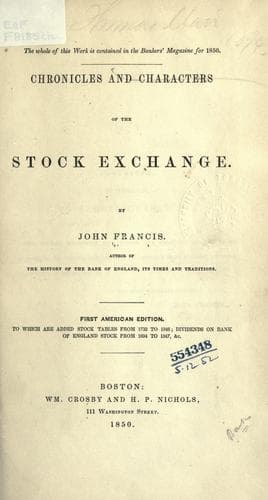
Chronicles and characters of the stock exchangeFrancis, John, of the Bank of England
History
Chronicles and characters of the stock exchange
Francis, John, of the Bank of England
Speculation; Stock Exchange (London, England)
From 1810 to 1815, the business in every department of the Stock
Exchange increased greatly. Loan after loan came rapidly forward,
was as rapidly taken, went to a premium, was merged in the funded
debt, and was succeeded by fresh demands for fresh loans. The public
feeling was so strong, even during those fearful campaigns which
preceded the fatal field of Austerlitz, when the futile threat
of invasion was frequent, and “the army of England” assembled at
Boulogne, that no ministry could have maintained its power unless
it had been a war ministry. And when the event of that battle,
known as the “battle of the three emperors,” was made public, when
the entire powers of the Continent were at the feet of Napoleon,
and William Pitt, the soul of the coalition, died from fear of the
calamities that threatened, the people of England were unchanged in
their resolute defiance. Enmity towards the French was an article of
faith. Hatred to their leader was taken from the mother’s breast, and
nourished by the stories which day by day engrossed the public mind,
or violated public feeling. At one time, the commercial world was
excited with the story that all the specie in all the private banks
of France had been seized. At another, some cruelty which outraged
humanity passed current with the vulgar. Stories of the conscription
harrowed the feelings of parents; tales of insurrection, suppressed
with heartless cruelty, raised the indignation of the child. The
evening fireside derived its great attraction from the talk about
Bonaparte; and it is no exaggeration to say, that nurses stilled
their querulous charges, or that mothers hushed their children, with
that dreaded name. Policies were opened on his life; and so uncertain
was it considered in 1804, that fifty-five guineas per cent. were
paid to insure it for one year. No fiction was more favorite or more
frequent than that which detailed his death; and in this the powerful
invention of the romancer was often proved. Poison and steel, the
dagger of the conspirator and the bullet of the republican, were
constantly asserted to have ended his career. On one occasion, it
was universally credited that the great Corsican was no more. A
despatch had been received by Lord Grenville announcing his death,
and circumstantially detailing its manner. No doubt was entertained;
the funds rose, and the news spread. Some very loyal persons set the
bells ringing in a suburban village, and the whole affair bore the
aspect of truth. The story circulated wore an appearance of romance
entirely in keeping with the career of the man whose death was
announced. It was stated that Napoleon, having called a council of
war, to which he had invited one of the wild chiefs of the desert,
who professed attachment till he could procure revenge, had been
shot by him in open council; and, on the signal thus given, the wild
hordes of the desert had slain Bonaparte and his devoted followers
in the land so recklessly invaded.
Public-domain text, read in full here on John Shaqi.
Reviews
Reviews
No reviews yet
Be the first to share your thoughts on this work.
Elsewhere in the archive
Join the Discussion
Join the discussion
Sign in to leave a comment or review.
Sign InorCreate an account