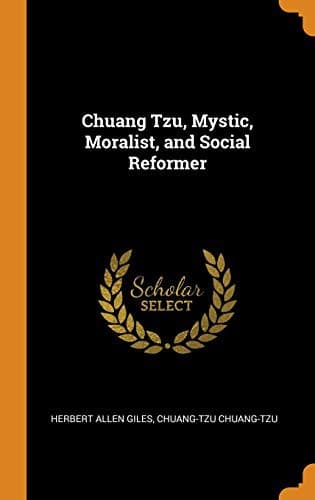
Chuang Tzu: Mystic, Moralist, and Social ReformerZhuangzi
Religion
Chuang Tzu: Mystic, Moralist, and Social Reformer
Zhuangzi
Ethics -- China; Philosophy, Chinese
"Rulers have abdicated under different conditions, dynasties have been
continued under different conditions. Those who did not hit off a
favourable time and were in opposition to their age,--they were called
usurpers. Those who did hit off the right time and were in harmony
with their age,--they were called patriots. Fair and softly, my River
friend; what should you know of value and worthlessness, of great and
small?"
It is therefore quite unnecessary to teach you where to fix the limits
of that of which you know nothing.
"In this case," replied the Spirit of the River, "what am I to do and
what am I not to do? How am I to arrange my declinings and receivings,
my takings-hold and my lettings-go?"
"From the point of view of TAO," said the Spirit of the Ocean, "value
and worthlessness are like slopes and plains.
A slope to-day may be a plain to-morrow.
To consider either as absolutely such would involve great injury to
TAO. Few and many are like giving and receiving presents. These must
not be regarded from one side, or there will be great confusion to TAO.
It would be unfair only to regard, from the receiver's standpoint, the
amount given. The intention of the giver must also be taken into the
calculation.
Be discriminating, as the ruler of a State whose administration is
impartial. Be dispassionate, as the worshipped deity whose dispensation
is impartial. Be expansive, like the points of the compass, to whose
boundlessness no limit is set. Embrace all creation, and none shall be
more sheltered than another. This is the unconditioned. And where all
things are equal, how can we have the long and the short?
"TAO is without beginning, without end. Other things are born and die.
They are impermanent; and now for better, now for worse, they are
ceaselessly changing form. Past years cannot be recalled: time cannot
be arrested. The succession of states is endless; and every end is
followed by a new beginning. Thus it may be said that man's duty to his
neighbour is embodied in the eternal principles of the universe.
All he has to _do_ is to _be_.
"The life of man passes by like a galloping horse, changing at every
turn, at every hour. What should he do, or what should he not do, other
than let his decomposition go on?"
"If this is the case," retorted the Spirit of the River, "pray what is
the value of TAO?"
"Those who understand TAO," answered the Spirit of the Ocean, "must
necessarily apprehend the eternal principles above mentioned and be
clear as to their application. Consequently, they do not suffer any
injury from without.
They never oppose, but let all things take their course.
"The man of perfect virtue cannot be burnt by fire, nor drowned in
water, nor hurt by frost or sun, nor torn by wild bird or beast. Not
that he makes light of these; but that he discriminates between safety
and danger. Happy under prosperous and adverse circumstances alike,
cautious as to what he discards and what he accepts;--nothing can harm
him.
Public-domain text, read in full here on John Shaqi.
Reviews
Reviews
No reviews yet
Be the first to share your thoughts on this work.
Elsewhere in the archive
Join the Discussion
Join the discussion
Sign in to leave a comment or review.
Sign InorCreate an account