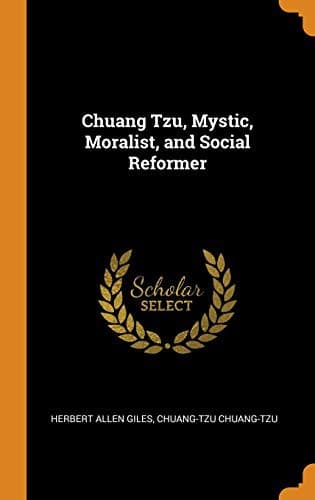
Chuang Tzu: Mystic, Moralist, and Social ReformerZhuangzi
Religion
Chuang Tzu: Mystic, Moralist, and Social Reformer
Zhuangzi
Ethics -- China; Philosophy, Chinese
conscious only that fate cannot save me from the inevitable
grave-yard,--then I am consuming life until at death it is as though
you and I had but once linked arms to be finally parted for ever! Is
not that indeed a cause for sorrow?
The motive of this involved paragraph is identical with that of Mr.
Mallock's famous essay _Is Life Worth Living?_
"Now you fix your attention upon something in me which, while you look,
has already passed away. Yet you seek for it as though it must be still
there,--like one who seeks for a horse in a market-place.
In the interim the animal has been sold.
What I admire in you is transitory. Nevertheless, why should you
grieve? Although my old self is constantly passing away, there remains
that which does not pass away."
The mind, which feeds and thrives upon change.
* * * * *
Confucius went to see Lao Tzŭ. The latter had just washed his head, and
his hair was hanging down his back to dry. He looked like a lifeless
body; so Confucius waited awhile, but at length approached and said,
"Do my eyes deceive me, or is this really so? Your frame, Sir, seems
like dry wood, as if it had been left without that which informs it
with the life of man."
Chuang Tzŭ (?) is here repeating himself.
"I was wandering," replied Lao Tzŭ, "in the unborn."
Reflecting upon the state of man before his birth into the world.
"What does that mean?" asked Confucius.
"My mind is trammelled," replied Lao Tzŭ, "and I cannot know. My mouth
is closed and I cannot speak. But I will try to tell you what is
probably the truth.
"The perfect Negative principle is majestically passive. The perfect
Positive principle is powerfully active. Passivity emanates from heaven
above; activity proceeds from earth beneath. The interaction of the two
results in that harmony by which all things are produced. There may
be a First Cause, but we never see his form. His report fills space.
There is darkness and light. Days come and months go. Work is being
constantly performed, yet we never witness the performance. Life must
bring us from somewhere, and death must carry us back. Beginning and
end follow ceaselessly one upon the other, and we cannot say when the
series will be exhausted. If this is not the work of a First Cause,
what is it?"
"Kindly explain," said Confucius, "what is to be got by wandering as
you said."
"The result," answered Lao Tzŭ, "is perfect goodness and perfect
happiness. And he who has these is a perfect man."
"And by what means," enquired Confucius, "can this be attained?"
"Animals," said Lao Tzŭ, "that eat grass do not mind a change of
pasture. Creatures that live in water do not mind a change of pond. A
slight change may be effected so long as the essential is untouched.
Public-domain text, read in full here on John Shaqi.
Reviews
Reviews
No reviews yet
Be the first to share your thoughts on this work.
Elsewhere in the archive
Join the Discussion
Join the discussion
Sign in to leave a comment or review.
Sign InorCreate an account