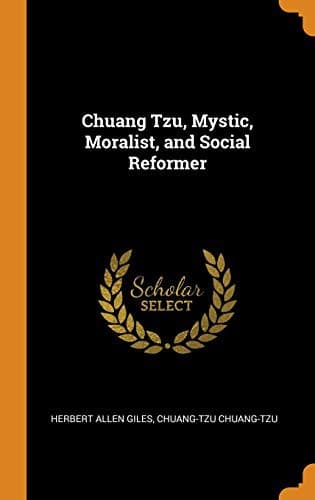
Chuang Tzu: Mystic, Moralist, and Social ReformerZhuangzi
Religion
Chuang Tzu: Mystic, Moralist, and Social Reformer
Zhuangzi
Ethics -- China; Philosophy, Chinese
" XXX--ON SWORDS 407
" XXXI--THE OLD FISHERMAN 413
" XXXII--LIEH TZŬ 423
" XXXIII--THE EMPIRE 437
INDEX 455
ERRATA AND ADDENDA 466
_Introduction._
Chuang Tzŭ[1] belongs to the third and fourth centuries before Christ.
He lived in the feudal age, when China was split up into a number of
States owning a nominal allegiance to the royal, and weakly, House of
Chou.
[1] Pronounce _Chwongdza_.
He is noticed by the historian Ssŭ-ma Ch'ien, who flourished at the
close of the second century B.C., as follows:--
Chuang Tzŭ was a native of Mêng.[2] His personal name was Chou.
He held a petty official post at Ch'i-yüan in Mêng.[3] He lived
contemporaneously with Prince Hui of the Liang State and Prince Hsüan
of the Ch'i State. His erudition was most varied; but his chief
doctrines are based upon the sayings of Lao Tzŭ.[4] Consequently,
his writings, which extend to over 100,000 words, are mostly
allegorical.[5]
[2] In the modern province of An-hui.
[3] Hence he is often spoken of in the book language as "Ch'i-yüan."
[4] Pronounce _Lowdza_. The _low_ as in _allow_. See p. vii.
[5] Of an imaginative character, in keeping with the visionary
teachings of his master.
He wrote _The Old Fisherman_, _Robber Chê_, and _Opening Trunks_, with
a view to asperse the Confucian school and to glorify the mysteries of
Lao Tzŭ.[6] _Wei Lei Hsü_, _Kêng Saṅg Tzŭ_, and the like, are probably
unsubstantial figments of his imagination.[7] Nevertheless, his
literary and dialectic skill was such that the best scholars of the
age proved unable to refute his destructive criticism of the Confucian
and Mihist schools.[8]
[6] See chs. xxxi, xxix, and x, respectively.
[7] The second of these personages is doubtless identical, though the
name is differently written, with the Kêng Sang Ch'u of ch. xxiii. The
identity of the first name has not been satisfactorily settled.
[8] See p. 17.
His teachings were like an overwhelming flood, which spreads at its
own sweet will. Consequently, from rulers and ministers downwards,
none could apply them to any definite use.[9]
[9] This last clause is based upon a famous passage in the _Lun
Yü:--The perfect man is not a mere thing; i.e._, his functions are
not limited. The idea conveyed is that Chuang Tzŭ's system was too
far-reaching to be practical.
Public-domain text, read in full here on John Shaqi.
Reviews
Reviews
No reviews yet
Be the first to share your thoughts on this work.
Join the Discussion
Join the discussion
Sign in to leave a comment or review.
Sign InorCreate an account