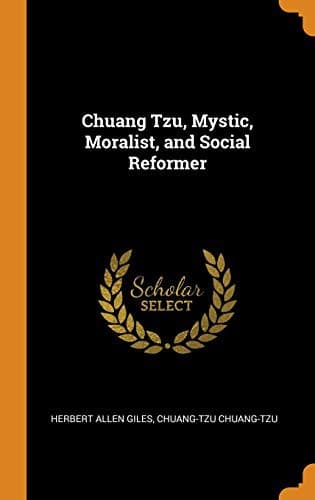
Chuang Tzu: Mystic, Moralist, and Social ReformerZhuangzi
Religion
Chuang Tzu: Mystic, Moralist, and Social Reformer
Zhuangzi
Ethics -- China; Philosophy, Chinese
Prince Wei of the Ch'u State, hearing of Chuang Tzŭ's good report,
sent messengers to him, bearing costly gifts, and inviting him to
become Prime Minister. At this Chuang Tzŭ smiled and said to the
messengers, "You offer me great wealth and a proud position indeed;
but have you never seen a sacrificial ox?--When after being fattened
up for several years, it is decked with embroidered trappings and led
to the altar, would it not willingly then change places with some
uncared-for pigling?... Begone! Defile me not! I would rather disport
myself to my own enjoyment in the mire than be slave to the ruler of
a State. I will never take office. Thus I shall remain free to follow
my own inclinations."[10]
[10] See p. 434.
To enable the reader to understand more fully the writings of Chuang
Tzŭ, and to appreciate his aim and object, it will be necessary to go
back a few more hundred years.
In the seventh century B.C., lived a man, now commonly spoken of as Lao
Tzŭ. He was the great Prophet of his age. He taught men to return good
for evil, and to look forward to a higher life. He professed to have
found the clue to all things human and divine.
He seems to have insisted that his system could not be reduced to
words. At any rate, he declared that those who spoke did not know,
while those who knew did not speak.
But to accommodate himself to conditions of mortality, he called this
clue TAO, or THE WAY, explaining that the word was to be understood
metaphorically, and not in a literal sense as the way or road upon
which men walk.
The following are sentences selected from the indisputably genuine
remains of Lao Tzŭ, to be found scattered here and there in early
Chinese literature:--
All the world knows that the goodness of doing good is not real
goodness.
When merit has been achieved, do not take it to yourself. On the other
hand, if you do not take it to yourself, it shall never be taken from
you.
By many words wit is exhausted. It is better to preserve a mean.
Keep behind, and you shall be put in front. Keep out, and you shall be
kept in.
What the world reverences may not be treated with irreverence.
Good words shall gain you honour in the market-place. Good deeds shall
gain you friends among men.
He who, conscious of being strong, is content to be weak,--he shall be
a cynosure of men.
The Empire is a divine trust, and may not be ruled. He who rules,
ruins. He who holds by force, loses.
Mighty is he who conquers himself.
He who is content, has enough.
To the good I would be good. To the not-good I would also be good, in
order to make them good.
If the government is tolerant, the people will be without guile. If
the government is meddling, there will be constant infraction of the
law.
Recompense injury with kindness.
The wise man's freedom from grievance is because he will not regard
grievances as such.
Public-domain text, read in full here on John Shaqi.
Reviews
Reviews
No reviews yet
Be the first to share your thoughts on this work.
Join the Discussion
Join the discussion
Sign in to leave a comment or review.
Sign InorCreate an account