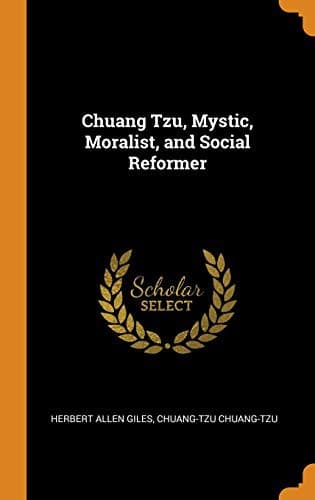
Chuang Tzu: Mystic, Moralist, and Social Reformer — John Shaqi
Chuang Tzu: Mystic, Moralist, and Social ReformerZhuangzi
Religion
Chuang Tzu: Mystic, Moralist, and Social Reformer
Zhuangzi
Ethics -- China; Philosophy, Chinese
"If then all things are ONE, what room is there for Speech? On the
other hand, since I can utter these words, how can Speech not exist?
"If it does exist, we have ONE and Speech = two; and two and one =
three. From which point onwards even the best mathematicians will fail
to reach:
TAO.
how much more then will ordinary people fail?
"Hence, if from nothing you can proceed to something, and subsequently
reach three, it follows that it would be still more easy if you were to
start from something. To avoid such progression, you must put yourself
into subjective relation with the external.
"Before conditions existed, TAO was. Before definitions existed, Speech
was. Subjectively, we are conscious of certain delimitations which
are,--
Right and Left
Relationship and Obligation
Division and Discrimination
Emulation and Contention
These are called the _Eight Predicables_.
Not, of course, in the strict logical sense.
For the true Sage, beyond the limits of an external world, they exist,
but are not recognised. By the true Sage, within the limits of an
external world, they are recognised, but are not assigned. And so,
with regard to the wisdom of the ancients, as embodied in the canon of
_Spring and Autumn_,
Confucius' history of his native State. Now one of the canonical books
of China.
the true Sage assigns, but does not justify by argument. And thus,
classifying he does not classify; arguing, he does not argue."
"How can that be?" asked Tzŭ Yu.
"The true Sage," answered Tzŭ Ch'i, "keeps his knowledge within him,
while men in general set forth theirs in argument, in order to convince
each other. And therefore it is said that in argument he does not
manifest himself.
Others try to establish their own subjective view. The true Sage
remains passive, aiming only at the annihilation of contraries.
"Perfect TAO does not declare itself. Nor does perfect argument express
itself in words. Nor does perfect charity show itself in act. Nor
is perfect honesty absolutely incorruptible. Nor is perfect courage
absolutely unyielding.
"For the TAO which shines forth is not TAO. Speech which argues falls
short of its aim. Charity which has fixed points loses its scope.
Honesty which is absolute is wanting in credit. Courage which is
absolute misses its object. These five are, as it were, round, with a
strong bias towards squareness. Therefore that knowledge which stops at
what it does not know, is the highest knowledge.
"Who knows the argument which can be argued without words?--the TAO
which does not declare itself as TAO? He who knows this may be said
to be of GOD. To be able to pour in without making full, and pour out
without making empty, in ignorance of the power by which such results
are accomplished,--this is accounted _Light_."
Of old, the Emperor Yao said to Shun, "I would smite the Tsungs, and
the Kueis, and the Hsü-aos. Ever since I have been on the throne I have
had this desire. What do you think?"
Public-domain text, read in full here on John Shaqi.
Reviews
Reviews
No reviews yet
Be the first to share your thoughts on this work.
Join the Discussion
Join the discussion
Sign in to leave a comment or review.
Sign InorCreate an account