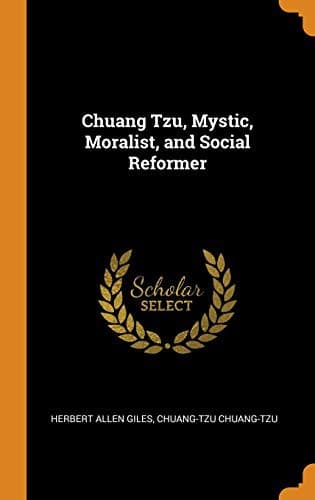
Chuang Tzu: Mystic, Moralist, and Social ReformerZhuangzi
Religion
Chuang Tzu: Mystic, Moralist, and Social Reformer
Zhuangzi
Ethics -- China; Philosophy, Chinese
as follows:--"I heard Confucius say, 'The true sage pays no heed to
mundane affairs. He neither seeks gain nor avoids injury. He asks
nothing at the hands of man. He adheres, without questioning, to TAO.
Without speaking, he can speak; and he can speak and yet say nothing.
And so he roams beyond the limits of this dusty world. These,' added
Confucius, 'are wild words.'
Han Fei Tzŭ tells us that Lao Tzŭ, whose doctrines Confucius seems to
be here deriding, said exactly the opposite of this; viz: "The true
Sage is beforehand in his attention to mundane affairs," _i.e._ "takes
time by the forelock." Neither utterance, however, appears in the
_Tao-Tê-Ching_. See _The Remains of Lao Tzŭ_, p. 44.
Now to me they are the skilful embodiment of TAO. What, Sir, is your
opinion?"
"Points upon which the Yellow Emperor doubted," replied Chang Wu Tzŭ,
"how should Confucius know?
Lao Tzŭ and the Yellow Emperor have always been mixed up in the heads
of Taoist writers, albeit separated by a chasm of some two thousand
years. Confucius is here evidently dealing with the actual doctrines
of Lao Tzŭ.
You are going too fast. You see your egg, and expect to hear it crow.
You look at your cross-bow, and expect to have broiled duck before you.
I will say a few words to you at random, and do you listen at random.
"How does the Sage seat himself by the sun and moon, and hold the
universe in his grasp? He blends everything into one harmonious whole,
rejecting the confusion of this and that. Rank and precedence, which
the vulgar prize, the Sage stolidly ignores. The revolutions of ten
thousand years leave his Unity unscathed. The universe itself may pass
away, but he will flourish still.
"How do I know that love of life is not a delusion after all? How do I
know but that he who dreads to die is not as a child who has lost the
way and cannot find his home?
"The lady Li Chi was the daughter of Ai Fêng.
A border chieftain.
When the Duke of Chin first got her, she wept until the bosom of
her dress was drenched with tears. But when she came to the royal
residence, and lived with the Duke, and ate rich food, she repented
of having wept. How then do I know but that the dead repent of having
previously clung to life?
"Those who dream of the banquet, wake to lamentation and sorrow. Those
who dream of lamentation and sorrow wake to join the hunt. While they
dream, they do not know that they dream. Some will even interpret the
very dream they are dreaming; and only when they awake do they know
it was a dream. By and by comes the Great Awakening, and then we find
out that this life is really a great dream. Fools think they are awake
now, and flatter themselves they know if they are really princes or
peasants. Confucius and you are both dreams; and I who say you are
dreams,--I am but a dream myself. This is a paradox. Tomorrow a sage
may arise to explain it; but that tomorrow will not be until ten
thousand generations have gone by.
Public-domain text, read in full here on John Shaqi.
Reviews
Reviews
No reviews yet
Be the first to share your thoughts on this work.
Join the Discussion
Join the discussion
Sign in to leave a comment or review.
Sign InorCreate an account