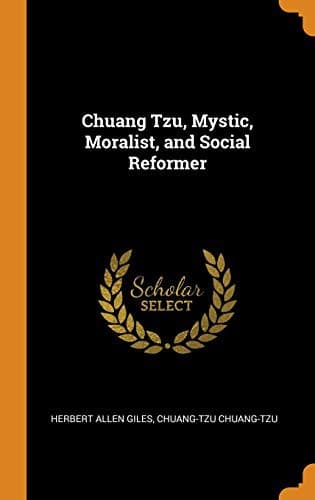
Chuang Tzu: Mystic, Moralist, and Social Reformer — John Shaqi
Chuang Tzu: Mystic, Moralist, and Social ReformerZhuangzi
Religion
Chuang Tzu: Mystic, Moralist, and Social Reformer
Zhuangzi
Ethics -- China; Philosophy, Chinese
Once upon a time, I, Chuang Tzŭ, dreamt I was a butterfly, fluttering
hither and thither, to all intents and purposes a butterfly. I was
conscious only of following my fancies as a butterfly, and was
unconscious of my individuality as a man. Suddenly, I awaked, and
there I lay, myself again. Now I do not know whether I was then a man
dreaming I was a butterfly, or whether I am now a butterfly dreaming I
am a man. Between a man and a butterfly there is necessarily a barrier.
The transition is called _Metempsychosis_.
Showing how one may appear to be either of two.
CHAPTER III.
NOURISHMENT OF THE SOUL.
_Argument_:--Life too short--Wisdom unattainable--Accommodation to
circumstances--Liberty paramount--Death a release--The soul immortal.
My life has a limit, but my knowledge is without limit. To drive the
limited in search of the limitless, is fatal; and the knowledge of
those who do this is fatally lost.
In striving for others, avoid fame. In striving for self, avoid
disgrace. Pursue a middle course. Thus you will keep a sound body, and
a sound mind, fulfil your duties, and work out your allotted span.
Prince Hui's cook was cutting up a bullock. Every blow of his hand,
every heave of his shoulders, every tread of his foot, every thrust of
his knee, every _whshh_ of rent flesh, every _chhk_ of the chopper, was
in perfect harmony,--rhythmical like the dance of the Mulberry Grove,
simultaneous like the chords of the Ching Shou.
Commentators are divided in their identifications of these ancient
_morceaux_.
"Well done!" cried the Prince. "Yours is skill indeed."
"Sire," replied the cook; "I have always devoted myself to TAO. It is
better than skill. When I first began to cut up bullocks, I saw before
me simply _whole_ bullocks. After three years' practice, I saw no more
whole animals.
Meaning that he saw them, so to speak, in sections.
And now I work with my mind and not with my eye. When my senses bid me
stop, but my mind urges me on, I fall back upon eternal principles.
I follow such openings or cavities as there may be, according to the
natural constitution of the animal. I do not attempt to cut through
joints: still less through large bones.
For a curious parallelism, see Plato's _Phædrus_, 265.
"A good cook changes his chopper once a year,--because he cuts. An
ordinary cook, once a month,--because he hacks. But I have had this
chopper nineteen years, and although I have cut up many thousand
bullocks, its edge is as if fresh from the whetstone. For at the joints
there are always interstices, and the edge of a chopper being without
thickness, it remains only to insert that which is without thickness
into such an interstice.
These words help to elucidate a much-vexed passage in ch. xliii of the
_Tao-Tê-Ching_. See _The Remains of Lao Tzŭ_, p. 30.
Public-domain text, read in full here on John Shaqi.
Reviews
Reviews
No reviews yet
Be the first to share your thoughts on this work.
Join the Discussion
Join the discussion
Sign in to leave a comment or review.
Sign InorCreate an account