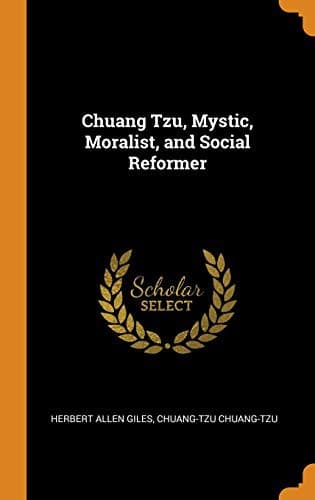
Chuang Tzu: Mystic, Moralist, and Social ReformerZhuangzi
Religion
Chuang Tzu: Mystic, Moralist, and Social Reformer
Zhuangzi
Ethics -- China; Philosophy, Chinese
By these means the interstice will be enlarged, and the blade will find
plenty of room. It is thus that I have kept my chopper for nineteen
years as though fresh from the whetstone.
"Nevertheless, when I come upon a hard part where the blade meets with
a difficulty, I am all caution. I fix my eye on it. I stay my hand, and
gently apply my blade, until with a _hwah_ the part yields like earth
crumbling to the ground. Then I take out my chopper, and stand up, and
look around, and pause, until with an air of triumph I wipe my chopper
and put it carefully away."
"Bravo!" cried the Prince. "From the words of this cook I have learnt
how to take care of my life."
Meaning that which informs life, _sc._ the soul.
When Hsien, of the Kung-wên family, beheld a certain official, he was
horrified, and said, "Who is that man? How came he to lose a foot? Is
this the work of God, or of man?
"Why, of course," continued Hsien, "it is the work of God, and not of
man. When God brought this man into the world, he wanted him to be
unlike other men. Men always have two feet. From this it is clear that
God and not man made him as he is.
It was by God's will that he took office with a view to personal
aggrandisement. That he got into trouble and suffered the common
punishment of loss of feet, cannot therefore be charged to man.
"Now, wild fowl get a peck once in ten steps, a drink once in a
hundred. Yet they do not want to be fed in a cage. For although they
would thus be able to command food, they would not be free."
And had our friend above kept out of the official cage he would still
have been independent as the fowls of the air.
When Lao Tzŭ died, Ch'in Shih went to mourn. He uttered three yells and
departed.
A disciple asked him saying, "Were you not our Master's friend?"
"I was," replied Ch'in Shih.
"And if so, do you consider that a sufficient expression of grief at
his loss?" added the disciple.
"I do," said Ch'in Shih. "I had believed him to be the man of all men,
but now I know that he was not. When I went in to mourn, I found old
persons weeping as if for their children, young ones wailing as if
for their mothers. And for him to have gained the attachment of those
people in this way, he too must have uttered words which should not
have been spoken, and dropped tears which should not have been shed,
thus violating eternal principles, increasing the sum of human emotion,
and forgetting the source from which his own life was received. The
ancients called such emotions the trammels of mortality. The Master
came, because it was his time to be born; he went, because it was his
time to die. For those who accept the phenomenon of birth and death in
this sense, lamentation and sorrow have no place. The ancients spoke
of death as of God cutting down a man suspended in the air. The fuel
is consumed, but the fire may be transmitted, and we know not that it
comes to an end."
Public-domain text, read in full here on John Shaqi.
Reviews
Reviews
No reviews yet
Be the first to share your thoughts on this work.
Join the Discussion
Join the discussion
Sign in to leave a comment or review.
Sign InorCreate an account