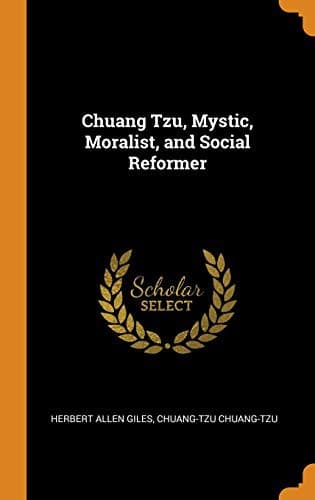
Chuang Tzu: Mystic, Moralist, and Social ReformerZhuangzi
Religion
Chuang Tzu: Mystic, Moralist, and Social Reformer
Zhuangzi
Ethics -- China; Philosophy, Chinese
"Now a minister often finds himself in circumstances over which he
has no control. But if he simply confines himself to his work, and
is utterly oblivious of self, what leisure has he for loving life or
hating death? And so you may safely go.
"But I have yet more to tell you. All intercourse, if personal, should
be characterised by sincerity. If from a distance, it should be carried
on in loyal terms. These terms will have to be transmitted by some one.
Now the transmission of messages of good- or ill-will is the hardest
thing possible. Messages of good-will are sure to be overdone with fine
phrases; messages of ill-will with harsh ones. In each case the result
is exaggeration, and a consequent failure to carry conviction, for
which the envoy suffers. Therefore it was said in the _Fa-yen_,
Name of an ancient book.
'Confine yourself to simple statements of fact, shorn of all
superfluous expression of feeling, and your risk will be small.'
"In trials of skill, at first all is friendliness; but at last it is
all antagonism. Skill is pushed too far. So on festive occasions, the
drinking which is in the beginning orderly enough, degenerates into
riot and disorder. Festivity is pushed too far. It is in fact the same
with all things: they begin with good faith and end with contempt. From
small beginnings come great endings.
"Speech is like wind to wave. Action is liable to divergence from its
true goal. By wind, waves are easily excited. Divergence from the
true goal is fraught with danger. Thus angry feelings rise up without
a cause. Specious words and dishonest arguments follow, as the wild
random cries of an animal at the point of death. Both sides give
way to passion. For where one party drives the other too much into a
corner, resistance will always be provoked without apparent cause. And
if the cause is not apparent, how much less will the ultimate effect be
so?
"Therefore it is said in the _Fa-yen_, 'Neither deviate from nor travel
beyond your instructions.
"Travel beyond your instructions," is literally, "urge a settlement."
To pass the limit is to go to excess.'
"To deviate from, or to travel beyond instructions, may imperil the
negotiation. A settlement to be successful must be lasting. It is too
late to change an evil settlement once made.
"Therefore let yourself be carried along without fear, taking refuge in
_no alternative_ to preserve you from harm on either side. This is the
utmost you can do. What need for considering your obligations? Better
leave all to Destiny, difficult as this may be."
It is passing strange that this exposition of the _laissez-aller_
inaction doctrine of TAO should be placed in the mouth of Confucius,
who is thus made in some measure to discredit his own teachings. The
commentators, however, see nothing anomalous in the position here
assigned to the Sage.
Yen Ho
A philosopher from the Lu State.
Public-domain text, read in full here on John Shaqi.
Reviews
Reviews
No reviews yet
Be the first to share your thoughts on this work.
Join the Discussion
Join the discussion
Sign in to leave a comment or review.
Sign InorCreate an account