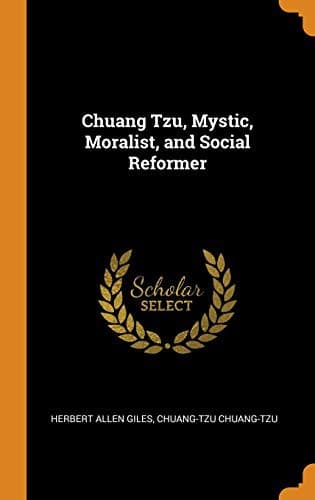
Chuang Tzu: Mystic, Moralist, and Social ReformerZhuangzi
Religion
Chuang Tzu: Mystic, Moralist, and Social Reformer
Zhuangzi
Ethics -- China; Philosophy, Chinese
"An old tree is cut down to make sacrificial vessels, which are then
ornamented with colour. The stump remains in a ditch. The sacrificial
vessels and the stump in the ditch are very differently treated as
regards honour and dishonour; equally, as far as destruction of the
woods original nature is concerned. Similarly, the acts of Robber Chê
and of Tsêng and Shih are very different; but the loss of original
nature is in each case the same.
"The causes of this loss are five in number; viz.--The five colours
confuse the eye, and the eyes fail to see clearly. The five sounds
confuse the ear, and the ear fails to hear accurately. The five scents
confuse the nose, and obstruct the sense of smell. The five tastes cloy
the palate, and vitiate the sense of taste. Finally, likes and dislikes
cloud the understanding, and cause dispersion of the original nature.
"These five are the banes of life; yet Yang and Mih regarded them as
the _summum bonum_.
As attainment of TAO. For Yang Chu and Mih Tzu, see chs. ii and viii.
They are not my _summum bonum_. For if men who are thus fettered can be
said to have attained the _summum bonum_, then pigeons and owls in a
cage may also be said to have attained the _summum bonum_!
"Besides, to stuff one's inside with likes and dislikes and sounds and
colours; to encompass one's outside with fur caps, feather hats, the
carrying of tablets, or girding of sashes--full of rubbish inside while
swathed in magnificence without--and still to talk of having attained
the _summum bonum_;--then the prisoner with arms tied behind him and
fingers in the squeezer, the tiger or the leopard which has just been
put in a cage, may justly consider that they too have attained the
_summum bonum_!"
"L'homme," says Rousseau (_op. cit._), "est né libre, et partout il
est dans les fers."
This chapter, as it stands, is clearly not from the hand of Chuang
Tzŭ. One critic justly points out the want of logical sequence in
arrangement of argument and illustrations. Another, while admitting
general refinement of style, calls attention to a superficiality of
thought noticeable in certain portions. "Yet only those," he adds,
"who eat and sleep with their Chuang Tzŭs would be able to detect
this."
CHAPTER XIII.
THE TAO OF GOD.
_Argument_:--TAO is repose--Repose the secret of the
universe--Cultivation of essentials--Neglect of accidentals--The
sequence of TAO--Spontaneity of true virtue--TAO is unconditioned--TAO
cannot be conveyed--Illustrations.
The TAO of GOD operates ceaselessly; and all things are produced. The
TAO of the sovereign operates ceaselessly; and the empire rallies
around him. The TAO of the Sage operates ceaselessly; and all within
the limit of surrounding ocean acknowledge his sway. He who apprehends
God, who is in relation with the Sage, and who recognises the radiating
virtue of the sovereign,--his actions will be to him unconscious, the
actions of repose.
Public-domain text, read in full here on John Shaqi.
Reviews
Reviews
No reviews yet
Be the first to share your thoughts on this work.
Elsewhere in the archive
Join the Discussion
Join the discussion
Sign in to leave a comment or review.
Sign InorCreate an account