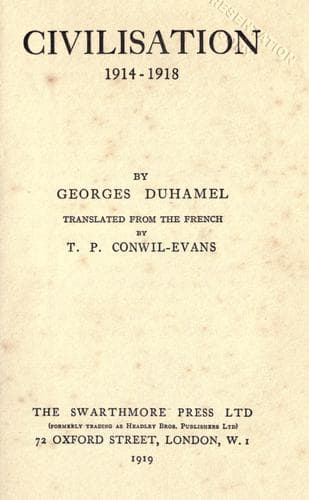
Short stories, French -- Translations into English; World War, 1914-1918 -- Fiction
I, too, had left in the invaded country those I loved, and also my
possessions. I felt, therefore, in the presence of Dauche the effect
of that solidarity which is aroused by a common misfortune. I ought,
however, to admit that my comrade had suffered more terrible calamities
than mine with greater fortitude, though he was more sensitive, as I
observed on several occasions.
Of pleasing height, Dauche had the pink complexion and the fair hair
characteristic of my country. A delicate beard adorned and prolonged
a face full of gentleness and life, like those young men whom Flemish
artists have portrayed, often so happily, wearing a frilled collar and
a heavy golden chain gleaming on a waistcoat of dark velvet.
A light bandage passed over his forehead. He seemed so little disturbed
by it that I did not trouble for some time to talk to him about his
wound. Besides, he never referred to it himself. I saw him once change
the dressing, and it was then that he explained to me in a few words
how a piece of grenade had struck him during a skirmish. He seemed to
treat the incident with the most perfect indifference.
“Nothing draws me away from the front,” he added, with a melancholy
smile, “and I was intending forthwith to return to my corps; but the
doctor is flatly opposed to it.”
He confessed it was not without pleasure that he looked forward to
spending the period of convalescence in the Château de S----, which
autumn adorned so nobly.
From the second week, in spite of the state of my wound on my shoulder,
I was given permission to walk a little. Dauche helped me with a
brotherly tenderness, and it was through his encouragement that I was
able soon to venture in the avenues of the park.
The doctor who looked after us both said to me in rather an embarrassed
tone:
“You are going out with Lieutenant Dauche? See that you don’t go too
far.”
This doctor was of a reticent nature. I did not ask for explanations; I
was confident in my recovered strength. It never struck me--naturally
enough--that the doctor was in fact thinking of Dauche.
Several days went by, blessed with all that is warm, young,
affectionate in a growing friendship. The war, among a thousand other
miseries, has compelled us to live occasionally in the company of
men whom in time of peace we should have carefully avoided. It was,
then, with a trembling joy that I recognised in Dauche those qualities
which would move my nature to love and affection--a nature which had
ever perhaps been unduly difficult and uneasy. I thought that a deep
predestined purpose operated there: the men of this age who can become
my friends are marked, and determined, in the universe with the same
mysterious sign; but I may not know them all, and perhaps I shall never
be fated to meet my best friend.
Public-domain text, read in full here on John Shaqi.
Reviews
Reviews
No reviews yet
Be the first to share your thoughts on this work.
Join the Discussion
Join the discussion
Sign in to leave a comment or review.
Sign InorCreate an account