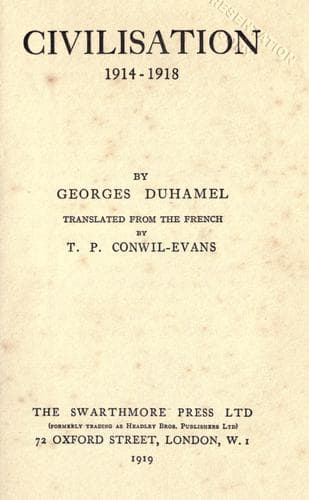
Short stories, French -- Translations into English; World War, 1914-1918 -- Fiction
The brilliant sunshine in which some vigour still remained, the
delicate tints of a landscape rich in the mists of early morning, and
perhaps a healthy desire to be cheerful and forget--all that suddenly
led my thoughts away from the depths into which they had sunk.
Dauche began running amid the tall grass, which was slowly fading to
a pale amber. His laughter, you would have said, was that of a boy.
Recounting all kinds of anecdotes and sayings, he played the games
loved by his own children, and sometimes he used to stop suddenly and
speak with respect and affection of the child he did not yet know, and
of the mother who waited for him in exile.
No natural thing seemed too trifling or unworthy of attention: he
delighted in the scent of the flowers, spared a momentary glance for
every object, rubbed the fragrant herbs between his fingers, and tasted
the blackberries and hazel nuts from the thickets.
He made me notice a thousand things whose existence until then, I blush
to think, I was scarcely aware of. He dragged me after him through an
endless series of adventures, and I could only follow him, awkwardly
and grumbling, like an old man forced to dance a _ronde_.
We were returning to the Château, congratulating ourselves on our
appetite and on the good time that we had had, when, in the bend of a
path, the words and the warning of the doctor burst with a shock upon
my consciousness. It was like a sharp imperious rap of the knuckle
against a door. I was aware then that I had never ceased thinking of it
in my subconsciousness. But looking once again at Dauche, sturdy and
blond like an ear of corn in the splendour of noon, I shook my head,
saying decidedly, “This worthy doctor is mistaken.”
And, during the whole of that day, I remained happy.
The next day, as I took a long time getting up, and, musing idly,
counted the gay flowers on the curtains, I caught, not far from me,
the regular breathing of Dauche, who was still sleeping. Immediately a
voice whispered in my ear, “That man is going to die.”
I turned over on my other side, and the voice repeated, “That man over
there is a dead man.”
Then I was seized with a desire to go away,--far away from Dauche and
from the Château, and to bury myself in the noise and activity of
civilian France.
I was completely awake, and began to reason the matter out with cold
deliberation.
“After all, I’ve known this man for so short a time and can do nothing
to help him. He has been in the hands of skilled surgeons who have
exhausted all the resources of their art for him.... I would forget
his terrible fate, as I had every right to in view of the fact that it
was shared by a large number of young men equally worthy of attention.
My presence could be of no use to him, and to be with him must indeed
often draw upon those reserves of moral energy of which I was strongly
in need.”
Public-domain text, read in full here on John Shaqi.
Reviews
Reviews
No reviews yet
Be the first to share your thoughts on this work.
Join the Discussion
Join the discussion
Sign in to leave a comment or review.
Sign InorCreate an account