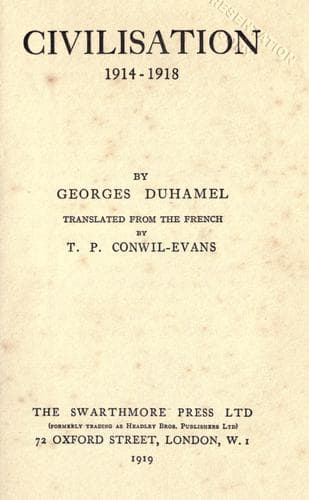
Short stories, French -- Translations into English; World War, 1914-1918 -- Fiction
These arguments ended in my asking the doctor, when I found myself
alone with him that same morning on some pretext or other, to hasten my
removal to another hospital.
“From the present state of your wound,” he said to me, “I see no
objection to it. I’ll see the thing is done.”
This ready assent, though so gratifying, caused me some surprise. But
my eye meeting the doctor’s, I found him looking so sad and perplexed
that I was ashamed.
I was, indeed, so upset by my weakness that at the end of a quarter of
an hour I went again to the doctor and asked if it wasn’t possible for
me to change my mind, and to remain at the Château de S---- until I had
completely recovered.
He smiled with a queer satisfied expression and assured me I could stay
as long as I liked.
My decision, arrived at after so much delay and evasion, brought calm
to my mind. I passed most of the day in my room and found diversion
in reading. Towards evening a soldier from a regiment stationed near
us, taking French leave, came to see us and invited us to hear two
musicians of his regiment who were giving a concert in an orange garden.
Though I had no precise intellectual understanding of music, I highly
appreciated it. And at that time I was, surely, in a position to remark
how a succession of notes and chords can interpret one’s prevailing
mood and quicken its emotions.
A violin sonata of Bach was being played with piano accompaniment.
Several times I felt as if an invisible and unknown person touched me
on the arm and whispered, “How can you forget he is going to die?”
I got up as soon as the concert ended and went quickly away, suffering
veritable torture.
“What is the matter?” asked Dauche, running after me. “You seem ill or
unhappy.”
“Both,” I replied, in a voice I could no longer control. “Didn’t you
hear the music of the violin?”
“Yes,” he said musingly; “it was pure joy.”
I looked at him furtively and withdrew nothing. But that evening, alone
with my thoughts in the dark, I understood that chance had reserved for
me a strange rôle to play in the fate of my friend--Dauche was doomed:
he had to die: he was about to die; but some one else, in some kind of
way, had to suffer his death-agony....
* * * * *
I am not, I protest, different from other people. The war had severely
tried me, but my imagination remained unclouded, and my wound was not
of such a kind as to impair the normal working of a healthy average
brain.
I am, therefore, thoroughly persuaded that the tense experience I
was to undergo, from that day, would have equally afflicted any man
confronted with the same calamitous circumstances.
Public-domain text, read in full here on John Shaqi.
Reviews
Reviews
No reviews yet
Be the first to share your thoughts on this work.
Join the Discussion
Join the discussion
Sign in to leave a comment or review.
Sign InorCreate an account