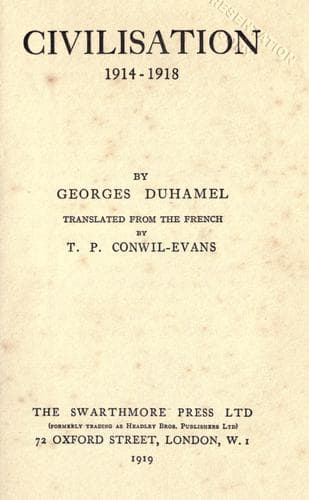
Short stories, French -- Translations into English; World War, 1914-1918 -- Fiction
There on the hillside, in a mosaic of plots, as it were, the vine
plantation could be seen, with the old woman, ever so small, who
was still sowing the ashes in the wind heavy with rain clouds. The
gentle country maintained in face of the stormy heavens an attitude
of innocence and resignation. Here and there, humble villages that
glistened seemed to be set like coloured jewels in the earth. And right
in the fields that were dressed for the needs of August, small specks
that moved could be seen: a race of old men were at grips with the
soil.
THE RAILWAY JUNCTION
To die is simple enough; only you should have the good taste to die in
some selected spot--unless, of course, you are in China, where the dead
are supreme and exercise almost more authority than the living. But in
our country you have got to die properly, otherwise the living will
look askance at you and say, “What does this corpse want? There’s no
room for it here.”
In 1915 I was going through a kind of probation period at the railway
junction of X., and I went on duty two or three times a week. Going
on duty meant being on the spot and doing small insignificant jobs,
being on guard or making a note of what was passing. Usually the man in
charge used to be found in some gloomy place leading to the lamp-room.
There he endured the long weary hours without interruption, and watched
the military trains passing, full of men who had undergone six months’
campaigning. They sang while they journeyed from one hell to another,
because in war men do not let their thoughts travel far; as soon
as they have got away from the guns they abandon themselves without
restraint to the joy of being alive.
One Saturday night I was lying on a thick mattress which served as a
bed. It was alive with mice. I felt these amiable little beasts at a
finger’s length from my ears, and I listened with wandering attention
to the noises coming from the junction. They were the sounds of a
great railway station: whistles, shrieks, puffing engines, cries of
the winches and the cranes, the vibrations of the taut iron rails,
the sharp clatter of the signals, the repeated clash of the buffers
of colliding trucks; and in the midst of it all, the clamour and the
rhythm of military movements, the swing of a detachment on the march,
the challenges of the sentries, commands, bell-ringings--all those
things which indicate the forcible possession by armed might of the
industrial organism.
My thoughts were running along these lines when I saw Corporal
Bonardent entering my dug-out, blinding me with the flare of his
acetylene lamp.
“Lieutenant!”
“I’m all attention, Bonardent.”
“Some poor devil in the food transport has just got himself done in, on
the semi-permanent way 17. I’m told it’s a dreadful----”
“Let’s go there at once, Corporal!”
Public-domain text, read in full here on John Shaqi.
Reviews
Reviews
No reviews yet
Be the first to share your thoughts on this work.
Join the Discussion
Join the discussion
Sign in to leave a comment or review.
Sign InorCreate an account