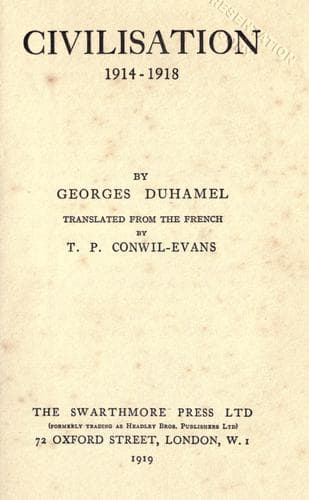
Short stories, French -- Translations into English; World War, 1914-1918 -- Fiction
Two men were waiting for me outside with a stretcher. It was a glorious
night, upon which the pale and flickering lights of the station hardly
made an impression.
“It’s at La Folie,” said Bonardent: “it’s rather far from here.”
La Folie is a road-crossing, about a mile off. I asked a porter how to
get there, and we started.
What is really amazing, in a large station, is that the organising
imperative will which directs the rush of moving things lies hidden
behind an apparent state of chaos and entanglement. We began to walk
along lines of trucks that never ended. They seemed to have been left
there and forgotten since the beginning of the war--rolling-stock
that appeared to have had its day, with stiffened axles and couplings
devoured by rust; but suddenly our lamp would light up an open door,
and some soldiers were seen in a heap, sleeping on the straw, or there
were cattle with stupefied looks. A few compartments had been turned
into travelling offices, where clerks drudged through a mass of papers
in a light reflected from a drawing-room lamp-shade; one felt that the
terrible grasp of the administration had closed over the railways, just
as its monstrous grip was in possession from the deep-dug trenches to
the outfitting shops far away in the Pyrenees. Sometimes, crossing
wide, dark spaces, we slipped between two trains that seemed petrified
with eternal sleep; but all at once, though no one could be seen, the
trains began to move towards each other, their ends clashing with a
terrific clatter. Farther on we had to stop while hospital trains were
passing. They afforded little comfort then, and there came to us, as
the trains went by, a broadside of heart-rending coughs and puffs
of the saturated chloride air with which the hospitals reeked. In
addition, there were masses of fat mortars lashed on trucks, heaps of
kitchens on wheels, and machinery whose uses one could not possibly
guess, and all sorts of munitions of war, which night made fantastic.
Heavy circular armour protected the cowering engines snorting in the
pale light of the arc lamps. There were also, reminding one of former
times, suburban trains that bore along drowsy passengers and express
trains that swept over the intricate lines swift as a lash of the whip.
In a word, a tumultuous roar, in which military movements clashed with
the routine of civilian life.
At last we arrived at La Folie. It was an inextricable network of
railways, discs, switches and metal cables. Three aged railway workers
were living there in a shed. They were in shirt sleeves, and were
turning the cranks, pulling the switches, directing with an orderly
calm born of experience all the whirling forces which accumulated in
that spot. They made me think of the foremen in past times who used to
carry on when the managing directors were indulging in the pleasures of
social life.
Above the rumbling noises a telegraph bell could be heard patiently
ringing.
“We have come for the A.S.C. man,” said Bonardent.
Public-domain text, read in full here on John Shaqi.
Reviews
Reviews
No reviews yet
Be the first to share your thoughts on this work.
Join the Discussion
Join the discussion
Sign in to leave a comment or review.
Sign InorCreate an account