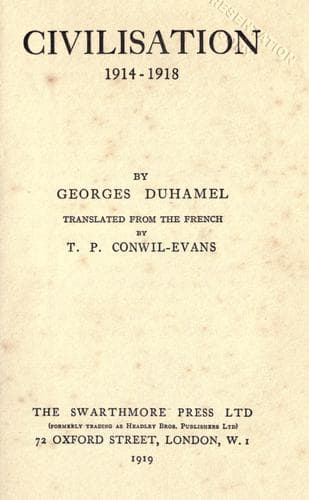
Short stories, French -- Translations into English; World War, 1914-1918 -- Fiction
“Oh! for that poor devil. He is there, under the sack and all around.
My God!”
We entered the zone occupied by the corpse. I say “zone” deliberately,
for the poor wretch had been cut up and scattered like a handful of
grain at seed-time.
“God in Heaven!” said a railwayman with white hair; “why did the poor
man come off the truck without looking round first? He made a terrible
mistake. Here there is too much traffic for anyone to leave one’s post.”
The face of the dead man was intact, but sixty trucks had passed over
his body, splitting it diagonally from the feet to the shoulders. We
picked up, in one place and another, the remains--bleeding pieces of
flesh, intestines, and, as I well remember, a hand clutching a piece
of cheese. Death had struck the man as he was eating.
The extraordinary thing was that his overcoat remained whole: it
concealed from view the hideous annihilation of the body. Lifting it
slightly, I saw his discipline book, on which one could decipher the
name Lamailleux.
“I think,” I said, “we’ve got him all now.”
An electric lamp, perched high up, gave a fitful light and seemed to be
suffering from irritating twitches.
I decided that we should take a short cut back across “The
Artillery”--a huge siding where munition trains had been shunted. But,
as we got near the railways, a sentry appeared:
“Halt! Who goes there?”
None of us had thought of the password. The territorial barred the way
with his rifle. He was adamant:
“I am sorry, Lieutenant, but you must go another way: those are my
orders.”
A long turning brought us before another sentry.
“The password, please! You can’t go through ‘The Artillery’ without it.”
“My friend, we are taking away a dead body.”
I raised the corner of the sacking and uncovered the bluish face.
In the light of the acetylene a portion of the pale skin with some
tattooed marks could be seen through the chaotic heap of clothes that
were saturated with blood. A look of horror passed over the guard’s
face, but he said again:
“Lieutenant, go along the main line! It’s not possible this way.”
We plunged back again along the network of rails, disturbed by the
clatter of the signals and the rumbling convoys. Sometimes the
exhausted stretcher-bearers stopped and placed their burden on the
stony embankment and carefully spat on their hands. Trains went by,
and we could see, in the bright compartments, women reading, tightly
clasping beautiful children who had fallen asleep.
At last the station lights came into view.
“Where are we taking the corpse?” I asked Bonardent.
“I don’t know, sir.”
I finally decided to present myself at the _Petite Vitesse_. A room
there had been taken to receive the wreckage cast off from the swirling
activity of the railway station--lost trunks, unemployed men, riderless
beasts, stores with no destination, and, when necessary, corpses. A
gendarme was smoking a cigarette in front of the door.
Public-domain text, read in full here on John Shaqi.
Reviews
Reviews
No reviews yet
Be the first to share your thoughts on this work.
Join the Discussion
Join the discussion
Sign in to leave a comment or review.
Sign InorCreate an account