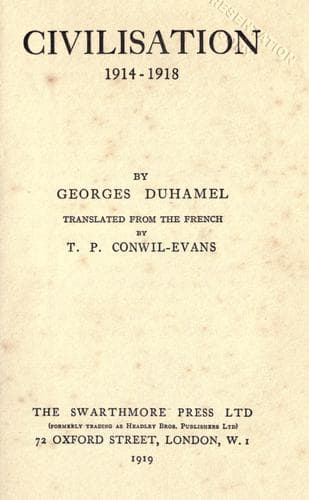
Short stories, French -- Translations into English; World War, 1914-1918 -- Fiction
Beneath the rows of poplar trees that stretched along the valley a huge
army had taken cover, with its battalions, its animals and wagons,
its iron and steel, its faded tarpaulins and leather trappings that
stank, and its refuse heaps. Horses nibbled at the bark of large
decaying trees, that were stricken with a premature autumnal disease.
Three meagre elm trees served as a shelter for a whole encampment: a
dusty hedge threw its protecting shadow over the ammunition train of
a regiment. But the vegetation was scarce and the shelter it afforded
most scanty, so that from all parts the army overflowed right on to the
bare plain, tearing up the surface of the roads and leaving a regular
network of tracks, as if great hordes of wild beasts had made their
passage along it.
There were roads that marked off the British from the French. There you
could see marching by the splendid artillery of the British, quite new
and glistening, fitted with light-coloured harness and nickel-plated
buckles, with special rugs for the horses, that were well fed and
gleaming like circus mounts.
The infantry were also filing past--young men, all of them. They
marched to the wild negro music of the flutes and gaily-coloured drums.
Then cars fitted with beds, tier upon tier, came slowly along, jolting
as little as possible, carrying the wounded fair-haired boys with
wondering eyes, looking as placid as a touring party of Cook’s.
Our villages were packed to suffocation. Man had got everywhere, like a
plague or a flood.
He had driven the cattle from their shelter and fixed his abode in
hutches, stables and cowsheds.
The shell depôts seemed like pottery fields full of earthenware
pitchers. Barges floated on the slimy water of the canal. Some carried
food and guns: others served as hospital-boats.
From the movements of this heaving mass of beings and the creaking of
their machinery, the panting of a giant seemed to issue forth and fill
the silence. The whole scene suggested a sinister fair, a festival of
war, a gathering of Bohemian clans and dancers of evil repute.
The nearer you got to Bray the more congested the country appeared to
be. The motor-riding population held tyrannic sway over the roads,
forcing the lowlier horse-wagons to drive across the fields. Little
trollies running on rails clanked along pompously, showing great
independence, hugging the ground with their small wheels, and their
back loaded with millions of cartridges: in amongst the boxes some
fellows were squatting, half asleep, proclaiming to the world in
general the pleasure of being seated on something which does all the
walking for you.
Public-domain text, read in full here on John Shaqi.
Reviews
Reviews
No reviews yet
Be the first to share your thoughts on this work.
Join the Discussion
Join the discussion
Sign in to leave a comment or review.
Sign InorCreate an account