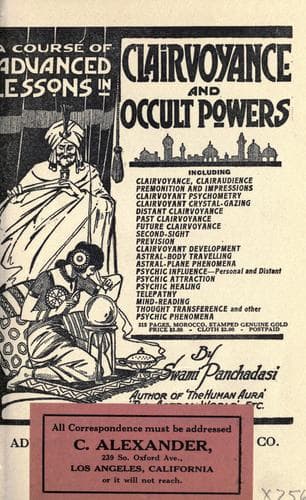
Clairvoyance and Occult PowersAtkinson, William Walker
Religion
Clairvoyance and Occult Powers
Atkinson, William Walker
Clairvoyance
The Western student, on the other hand, is accustomed to maintaining the
skeptical attitude of mind--the scientific attitude of doubt and demand
for proof--and the teacher so understands it. Both are accustomed to
illustrations bringing out the principles involved, but these
illustrations must not be fanciful or figurative--they must be actual
cases, well authenticated and vouched for as evidence. In short, the
Western teacher is expected to actually "prove" to his students his
principles and methods, before he may expect them to be accepted. This, of
course, not from any real doubt or suspicion of the veracity or ability of
the teacher, but merely because the Western mind expects to question, and
be questioned, in this way in the process of teaching and learning.
Consequently, in this series of lessons, I have sought to follow the
Western method rather than the Hindu. So far as is possible, I have
avoided the flat positive statement of principles and methods, and have
sought to prove each step of the teaching. Of course, I have been
compelled to assume the existence of certain fundamental principles, in
order to avoid long and technical metaphysical and philosophical
discussions. I have also had to content myself with the positive flat
assertion of the existence of the Astral Plane, Akashic Records, Prana,
etc., which are fundamental postulates of Hindu philosophy and occult
science--for these are established solely by the experience of those who
are able to function on the higher planes themselves. But, beyond this I
have sought to prove by direct and positive evidence (adapted to the
Western mind) every step of my teaching and methods.
In offering this scientific proof, I have purposely omitted (except in a
few instances) all mention of occult or psychic phenomena occurring in
India, and have confined myself to instances occurring in Western lands to
Western persons. Moreover, I have avoided quoting and citing Hindu
authorities, and have, instead, quoted and cited from authorities well
known and respected in Western lands, such as the Society for Psychical
Research, and the prominent scientists interested in the work of the said
society. In this way I have sought to furnish the Western student with
examples, cases, and illustrations familiar to him, and easily referred
to. Had I cited Indian cases, I might be accused of offering proof that
could not be easily verified; and quoting persons unknown to my readers.
There is a wealth of such cases and illustration in India, naturally, but
these as a rule are traditional and not available in printed form; and
these would not likely be very satisfactory to the Western student.
Public-domain text, read in full here on John Shaqi.
Reviews
Reviews
No reviews yet
Be the first to share your thoughts on this work.
Join the Discussion
Join the discussion
Sign in to leave a comment or review.
Sign InorCreate an account