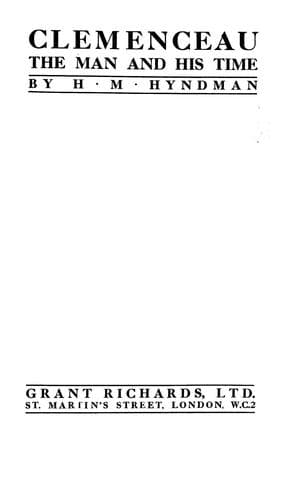
Clemenceau, the Man and His TimeHyndman, H. M. (Henry Mayers)
History
Clemenceau, the Man and His Time
Hyndman, H. M. (Henry Mayers)
Clemenceau, Georges, 1841-1929; France -- Politics and government -- 1870-1940
half tricked into a hopeless campaign, and every calculation on which
Bismarck relied was verified by the results. Nay, the plébiscite which
Louis Napoleon risked eighteen years after the _coup d'état_ went
entirely in his favour, and it was in reality quite unnecessary, from
the point of view of internal politics, that any risk of war should
be run. The Empress, however, has always had the discredit of not
having been of that opinion. Hence steps were taken which played into
Bismarck's hands.
At first, as I have heard Clemenceau say himself, it was almost
impossible for a patriotic Republican to desire victory for the
French armies. That would only have meant a new life for the decadent
Empire. Sad, therefore, as was the long succession of disasters, and
terrible the devastation wrought by German ruthlessness, not until
the culminating defeat of Sedan, the surrender of Napoleon and the
decree of Imperial overthrow pronounced by the people of Paris, could
men feel that French soldiers were really fighting for their country.
Thenceforward the struggle was between democratic and progressive
France and autocratic and reactionary Prussia. The Empire for whose
humiliation the King of Prussia had gone to war existed no longer. A
Republic was at once declared in its place. Any fair-minded enemy would
directly have offered the easiest possible terms for peace to the new
France. But that was not the view of Prussia. France, not merely the
Second Empire, was to be defeated and crushed down, because she stood
in the way of that permanent policy of aggression and aggrandisement
to which the House of Hohenzollern, with its Junker supporters, has
always been devoted. This was the moment when England should have
interfered decisively on the side of her old rival. It was not only
our interest but our duty to do so, and the whole nation would have
enthusiastically supported the statesmen who had given it a vigorous
lead in the right direction. Unfortunately Queen Victoria, then as
ever bitterly pro-German, was utterly unscrupulous in enforcing her
views upon her Government: the men then in office were essentially
courtiers, who combined servility at home with pusillanimity abroad:
the _laissez-faire_ school of parasitical commercialism which regards
the accumulation of wealth for the few as the highest aspiration of
humanity held the trading classes in its grip. Consequently, the
monarch and the ruling class of the day thought it was cheaper, and
therefore better, to leave France to her fate, and make a good cash
profit out of the business, rather than courageously to withstand the
beginnings of evil and uphold the French Republic against the brutality
and greed of Berlin. It is sad, nearly fifty years later, to reflect
upon the results of this mistaken and cowardly policy. The war was
continued, owing chiefly to English indifference, until France lay at
the feet of the conquerors.
Public-domain text, read in full here on John Shaqi.
Reviews
Reviews
No reviews yet
Be the first to share your thoughts on this work.
Join the Discussion
Join the discussion
Sign in to leave a comment or review.
Sign InorCreate an account