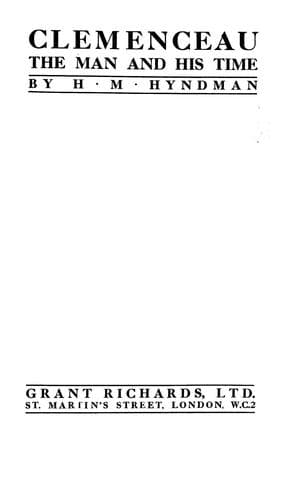
Clemenceau, the Man and His TimeHyndman, H. M. (Henry Mayers)
History
Clemenceau, the Man and His Time
Hyndman, H. M. (Henry Mayers)
Clemenceau, Georges, 1841-1929; France -- Politics and government -- 1870-1940
From the first Clemenceau had vigorously opposed the establishment
of a Second Chamber in the shape of a Senate divorced from a direct
popular vote. This was a step calculated to hamper progress at every
turn, and at critical moments to intensify those very antagonisms which
it was Gambetta's intention, no doubt, to compose entirely, or at any
rate to mitigate. Clemenceau did not view the matter from Gambetta's
point of view. The Monarchists and Buonapartists were the domestic
enemy, as the Germans had been and might be again the foreign enemy.
The only sound policy for strengthening the Republic to resist both
was to favour those measures political and social which would make
that Republic, which they had established with so much difficulty and
at such great cost, a genuinely democratic Republic. Any surrender to
the reactionists and the clericals must inevitably dishearten those
parties, now shown to be the majority of the whole French people, who
were for the Republic and the Republic alone. Opportunism also gave
the anti-democrats and intriguers a false notion of their own power,
virtually helped them to carry on their underground agitations for a
change of the new constitution, and provided them in the undemocratic
Senate with a political force that might be turned to their own purpose.
It was more important all through, thought Clemenceau, to inspire
your own side with confidence than to placate your opponents by
half-measures. It was, in fact, not enough to eject officials who were
known to be hostile to the Republic; it was still more essential to
give such shape to the political forms and so vivify political opinion
that even the most unscrupulous officials could not turn them to the
account of reaction. Both steps were necessary to carry out a thorough
democratic programme. In fact, the whole scheme of administration in
France could not be permanently improved merely by substituting one set
of bureaucrats for another. Much more drastic measures of a peaceful
character were indispensable, and these Opportunism thwarted. Gambetta
may not have given up his desire to carry these Radical measures in
1877 and 1878: he still retained and expressed his old opinions upon
clericalism and its sinister influence. But he was no longer the
vehement champion of the advanced party at Versailles, and the position
which he had abandoned Clemenceau took up and pushed further to the
front.
Public-domain text, read in full here on John Shaqi.
Reviews
Reviews
No reviews yet
Be the first to share your thoughts on this work.
Join the Discussion
Join the discussion
Sign in to leave a comment or review.
Sign InorCreate an account