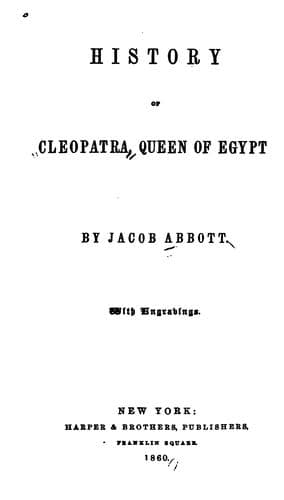
Cleopatra, Queen of Egypt, -30 B.C.; Egypt -- History -- 332-30 B.C. -- Biography; Queens -- Egypt -- Biography
It was in these ages, before other nations had intruded upon its
peaceful seclusion, that the Pyramids were built, and the enormous
monoliths carved, and those vast temples reared whose ruined columns are
now the wonder of mankind. During these remote ages, too, Egypt was, as
now, the land of perpetual fertility and abundance. There would always
be corn in Egypt, wherever else famine might rage. The neighboring
nations and tribes in Arabia, Palestine, and Syria, found their way to
it, accordingly, across the deserts on the eastern side, when driven by
want, and thus opened a way of communication. At length the Persian
monarchs, after extending their empire westward to the Mediterranean,
found access by the same road to Pelusium, and thence overran and
conquered the country. At last, about two hundred and fifty years before
the time of Cleopatra, Alexander the Great, when he subverted the
Persian empire, took possession of Egypt, and annexed it, among the
other Persian provinces, to his own dominions. At the division of
Alexander's empire, after his death, Egypt fell to one of his generals,
named Ptolemy. Ptolemy made it his kingdom, and left it, at his death,
to his heirs. A long line of sovereigns succeeded him, known in history
as the dynasty of the Ptolemies--Greek princes, reigning over an
Egyptian realm. Cleopatra was the daughter of the eleventh in the line.
The capital of the Ptolemies was Alexandria. Until the time of
Alexander's conquest, Egypt had no sea-port. There were several
landing-places along the coast, but no proper harbor. In fact Egypt had
then so little commercial intercourse with the rest of the world, that
she scarcely needed any. Alexander's engineers, however, in exploring
the shore, found a point not far from the Canopic mouth of the Nile
where the water was deep, and where there was an anchorage ground
protected by an island. Alexander founded a city there, which he called
by his own name. He perfected the harbor by artificial excavations and
embankments. A lofty light-house was reared, which formed a landmark by
day, and exhibited a blazing star by night to guide the galleys of the
Mediterranean in. A canal was made to connect the port with the Nile,
and warehouses were erected to contain the stores of merchandise. In a
word, Alexandria became at once a great commercial capital. It was the
seat, for several centuries, of the magnificent government of the
Ptolemies; and so well was its situation chosen for the purposes
intended, that it still continues, after the lapse of twenty centuries
of revolution and change, one of the principal emporiums of the commerce
of the East.
CHAPTER II.
THE PTOLEMIES.
Public-domain text, read in full here on John Shaqi.
Reviews
Reviews
No reviews yet
Be the first to share your thoughts on this work.
Join the Discussion
Join the discussion
Sign in to leave a comment or review.
Sign InorCreate an account