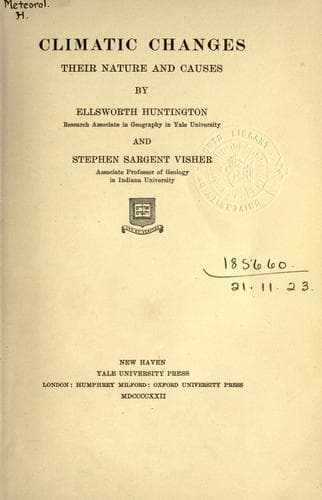
Climatic Changes: Their Nature and CausesHuntington, Ellsworth
Science
Climatic Changes: Their Nature and Causes
Huntington, Ellsworth
Climatic changes; Climatology; Paleoclimatology
large body of material composing the loess except by assuming the
existence of great deserts to windward. But there seems to be little or
no evidence of such deserts where they could be effective. The
mineralogical character of the loess of Iowan age proves that the
material came from granitic rocks, such as formed a large part of the
drift. The nearest extensive outcrops of granite are in the southwestern
part of the United States, nearly a thousand miles from Iowa and
Illinois. But the loess is thickest near the ice margin and thins toward
the southwest and in other directions, whereas if its source were the
southwestern desert, its maximum thickness would probably be near the
margin of the desert.
The evidence cited above seems inconsistent not only with the hypothesis
that the loess was formed at the end of an inter-glacial epoch, but also
with the idea that it originated at times of maximum glaciation either
from river-borne sediments or from any other source. A further and more
convincing reason for this last conclusion is the probability and almost
the certainty that when the ice advanced, its front lay close to areas
where the vegetation was not much thinner than that which today prevails
under similar climatic conditions. If the average temperature of glacial
maxima was only 6 deg.C. lower than that of today, the conditions just
beyond the ice front when it was in the loess region from southern
Illinois to Minnesota would have been like those now prevailing in
Canada from New Brunswick to Winnipeg. The vegetation there is quite
different from the grassy, semi-arid vegetation of which evidence is
found in the loess. The roots and stalks of such grassy vegetation are
generally agreed to have helped produce the columnar structure which
enables the loess to stand with almost vertical surfaces.
Public-domain text, read in full here on John Shaqi.
Reviews
Reviews
No reviews yet
Be the first to share your thoughts on this work.
Elsewhere in the archive
Join the Discussion
Join the discussion
Sign in to leave a comment or review.
Sign InorCreate an account