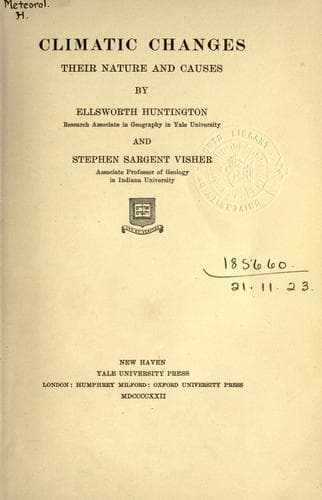
Climatic Changes: Their Nature and CausesHuntington, Ellsworth
Science
Climatic Changes: Their Nature and Causes
Huntington, Ellsworth
Climatic changes; Climatology; Paleoclimatology
Students of paleontology hold that as far back as we can go in the study
of plants, there are evidences of seasons and of relatively cool
climates in high latitudes. The cycads, for instance, are one of the
types most often used as evidence of a warm climate. Yet Wieland,[61]
who has made a lifelong study of these plants, says that many of them
"might well grow in temperate to cool climates. Until far more is
learned about them they should at least be held as valueless as indices
of tropic climates." The inference is "that either they or their close
relatives had the capacity to live in every clime. There is also a
suspicion that study of the associated ferns may compel revision of the
long-accepted view of the universality of tropic climates throughout the
Mesozoic." Nathorst is quoted by Wieland as saying, "I think ... that
during the time when the Gingkophytes and Cycadophytes dominated, many
of them must have adapted themselves for living in cold climates also.
Of this I have not the least doubt."
Another important line of evidence which Knowlton and others have cited
as a proof of the non-zonal arrangement of climate in the past, is the
vast red beds which are found in the Proterozoic, late Silurian,
Devonian, Permian, and Triassic, and in some Tertiary formations. These
are believed to resemble laterite, a red and highly oxidized soil which
is found in great abundance in equatorial regions. Knowlton does not
attempt to show that the red beds present equatorial characteristics in
other respects, but bases his conclusion on the statement that "red beds
are not being formed at the present time in any desert region." This is
certainly an error. As has already been said, in both the Transcaspian
and Takla Makan deserts, the color of the sand regularly changes from
brown on the borders to pale red far out in the desert. Kuzzil Kum, or
Red Sand, is the native name. The sands in the center of the desert
apparently were originally washed down from the same mountains as those
on the borders, and time has turned them red. Since the same condition
is reported from the Arabian Desert, it seems that redness is
characteristic of some of the world's greatest deserts. Moreover, beds
of salt and gypsum are regularly found in red beds, and they can
scarcely originate except in deserts, or in shallow almost landlocked
bays on the coasts of deserts, as appears to have happened in the
Silurian where marine fossils are found interbedded with gypsum.
Again, Knowlton says that red beds cannot indicate deserts because the
plants found in them are not "pinched or depauperate, nor do they
indicate xerophytic adaptations. Moreover, very considerable deposits of
coal are found in red beds in many parts of the world, which implies the
presence of swamps but little above sea-level."
Public-domain text, read in full here on John Shaqi.
Reviews
Reviews
No reviews yet
Be the first to share your thoughts on this work.
Elsewhere in the archive
Join the Discussion
Join the discussion
Sign in to leave a comment or review.
Sign InorCreate an account