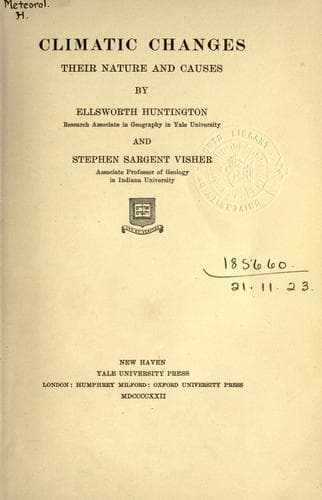
Climatic Changes: Their Nature and CausesHuntington, Ellsworth
Science
Climatic Changes: Their Nature and Causes
Huntington, Ellsworth
Climatic changes; Climatology; Paleoclimatology
Students of desert botany are likely to doubt the force of these
considerations. As MacDougal[62] has shown, the variety of plants in
deserts is greater than in moist regions. Not only do xerophytic desert
species prevail, but halophytes are present in the salty areas, and
hygrophytes in the wet swampy areas, while ordinary mesophytes prevail
along the water courses and are washed down from the mountains. The
ordinary plants, not the xerophytes, are the ones that are chiefly
preserved since they occur in most abundance near streams where
deposition is taking place. So far as swamps are concerned, few are of
larger size than those of Seistan in Persia, Lop Nor in Chinese
Turkestan, and certain others in the midst of the Asiatic deserts.
Streams flowing from the mountains into deserts are almost sure to form
large swamps, such as those along the Tarim River in central Asia. Lake
Chad in Africa is another example. In it, too, reeds are very numerous.
Putting together the evidence on both sides in this disputed question,
it appears that throughout most of geological time there is some
evidence of a zonal arrangement of climate. The evidence takes the form
of traces of cool climates, of seasons, and of deserts. Nevertheless,
there is also strong evidence that these conditions were in general less
intense than at present and that times of relatively warm, moist climate
without great seasonal extremes have prevailed very widely during
periods much longer than those when a zonal arrangement as marked as
that of today prevailed. As Schuchert[63] puts it: "Today the variation
on land between the tropics and the poles is roughly between 110 deg. and
-60 deg.F., in the oceans between 85 deg. and 31 deg.F. In the geologic past the
temperature of the oceans for the greater parts of the periods probably
was most often between 85 deg. and 55 deg.F., while on land it may have varied
between 90 deg. and 0 deg.F. At rare intervals the extremes were undoubtedly as
great as they are today. The conclusion is therefore that at all times
the earth had temperature zones, varying between the present-day
intensity and times which were almost without such belts, and at these
latter times the greater part of the earth had an almost uniformly mild
climate, without winters."
Public-domain text, read in full here on John Shaqi.
Reviews
Reviews
No reviews yet
Be the first to share your thoughts on this work.
Elsewhere in the archive
Join the Discussion
Join the discussion
Sign in to leave a comment or review.
Sign InorCreate an account