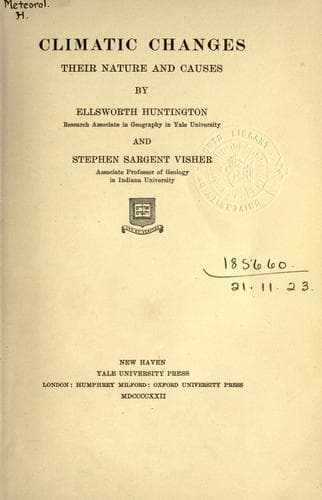
Climatic Changes: Their Nature and CausesHuntington, Ellsworth
Science
Climatic Changes: Their Nature and Causes
Huntington, Ellsworth
Climatic changes; Climatology; Paleoclimatology
Certain varieties of soy beans change their behavior in a peculiar
manner with advance of the summer season. The variety known as
Biloxi, for example, when planted early in the spring in the
latitude of Washington, D. C., continues to grow throughout the
summer, flowering in September. The plants maintain growth without
flowering for fifteen to eighteen weeks, attaining a height of five
feet or more. As the dates of successive plantings are moved forward
through the months of June and July, however there is a marked
tendency for the plants to cut short the period of growth which
precedes flowering. This means, of course, that there is a tendency
to flower at approximately the same time of year regardless of the
date of planting. As a necessary consequence, the size of the plants
at the time of flowering is reduced in proportion to the delay in
planting.
The bearing of this on geological problems lies in a query which it
raises as to the ability of a genus or family of plants to adapt itself
to days of very different length from those to which it is wonted. Could
tree ferns, ginkgos, cycads, and other plants whose usual range of
location never subjects them to daylight for more than perhaps fourteen
hours or less than ten, thrive and reproduce themselves if subjected to
periods of daylight ranging all the way from nothing up to about
twenty-four hours? No answer to this is yet possible, but the question
raises most interesting opportunities of investigation. If Cordeiro is
right as to the earth's elastic gyroscopic motion, there may have been
certain periods when a vertical or almost vertical axis permitted the
days to be of almost equal length at all seasons in all latitudes. If
such an absence of seasons occurred when the lands were low, when the
oceans were extensive and widely open toward the poles, and when storms
were relatively inactive, the result might be great mildness of climate
such as appears sometimes to have prevailed in the middle of geological
eras. Suppose on the other hand that the axis should be tilted more than
now, and that the lands should be widely emergent and the storm belt
highly active in low latitudes, perhaps because of the activity of the
sun. The conditions might be favorable for glaciation at latitudes as
low as those where the Permo-Carboniferous ice sheets appear to have
centered. The possibilities thus suggested by Cordeiro's hypothesis are
so interesting that the gyroscopic motion of the earth ought to be
investigated more thoroughly. Even if no such gyroscopic motion takes
place, however, the other causes of mild climate discussed in this
chapter may be enough to explain all the observed phenomena.
Public-domain text, read in full here on John Shaqi.
Reviews
Reviews
No reviews yet
Be the first to share your thoughts on this work.
Elsewhere in the archive
Join the Discussion
Join the discussion
Sign in to leave a comment or review.
Sign InorCreate an account