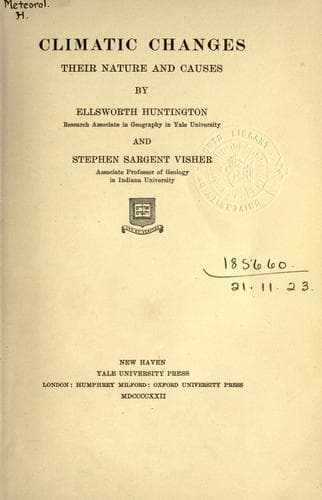
Climatic Changes: Their Nature and CausesHuntington, Ellsworth
Science
Climatic Changes: Their Nature and Causes
Huntington, Ellsworth
Climatic changes; Climatology; Paleoclimatology
Another suggestion of such periodic equatorward movements of the ocean
water is found in the reported contrast between the relative stability
with which the northern part of North America has remained slightly
above sea level except at times of widespread submergence, while the
southern parts have suffered repeated submergence alternating with great
emergence.[78] Furthermore, although the northern part of North America
has been generally exposed to erosion since the Proterozoic, it has
supplied much less sediment than have the more southern land areas.[79]
This apparently means that much of Canada has stood relatively low,
while repeated and profound uplift alternating with depression has
occurred in subtropical latitudes, apparently in adjustment to changes
in the earth's speed of rotation. The uplifts generally followed the
times of submergence due to equatorward movement of the water, though
the buckling of the crust which accompanies shrinkage doubtless caused
some of the submergence. The evidence that northern North America stood
relatively low throughout much of geological time depends not only on
the fact that little sediment came to the south from the north, but also
on the fact that at times of especially widespread epicontinental seas,
the submergence was initiated at the north.[80] This is especially true
for Ordovician, Silurian, Devonian, and Jurassic times in North America.
General submergence of this kind is supposed to be due chiefly to the
overflowing of the ocean when its level is slowly raised by the
deposition of sediment derived from the erosion of what once were
continental highlands but later are peneplains. The fact that such
submergence began in high latitudes, however, seems to need a further
explanation. The bulging of the rock sphere at the equator and the
consequent displacement of some of the water in low latitudes would
furnish such an explanation, as would also a decrease in the speed of
rotation induced by tidal retardation, if that retardation were great
enough and rapid enough to be geologically effective.
The climatic effects of the earth's contraction, which we shall shortly
discuss, are greatly complicated by the fact that contraction has taken
place irregularly. Such irregularity has occurred in spite of the fact
that the processes which cause contraction have probably gone on quite
steadily throughout geological history. These processes include the
chemical reorganization of the minerals of the crust, a process which is
illustrated by the metamorphism of sedimentary rocks into crystalline
forms. The escape of gases through volcanic action or otherwise has been
another important process.
Public-domain text, read in full here on John Shaqi.
Reviews
Reviews
No reviews yet
Be the first to share your thoughts on this work.
Elsewhere in the archive
Join the Discussion
Join the discussion
Sign in to leave a comment or review.
Sign InorCreate an account