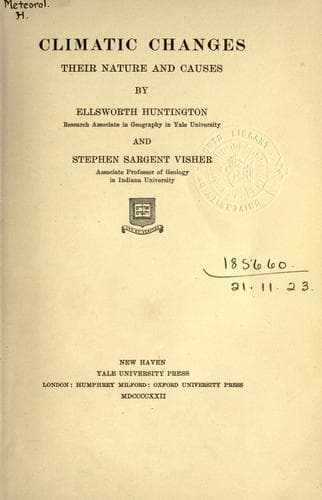
Climatic Changes: Their Nature and CausesHuntington, Ellsworth
Science
Climatic Changes: Their Nature and Causes
Huntington, Ellsworth
Climatic changes; Climatology; Paleoclimatology
Altogether the problem of how the sun can have remained so uniform and
how the earth's atmosphere and other conditions can also have remained
so uniform throughout hundreds of millions of years is one of the most
puzzling in the whole realm of nature. If appeal is taken to
radioactivity and the breaking up of uranium into radium and helium,
conditions can be postulated which will give the required amount of
energy. Such is also the case if it be supposed that there is some
unknown process which may induce an atomic change like radioactivity in
bodies which are now supposed to be stable elements. In either case,
however, there is as yet no satisfactory explanation of the _uniformity_
of the earth's climate. A hundred million or a thousand million years
ago the temperature of the earth's surface was very much the same as
now. The earth had then presumably ceased to emit any great amount of
heat, if we may judge from the fact that its surface was cool enough so
that great ice sheets could accumulate on low lands within 40 deg. of the
equator. The atmosphere was apparently almost like that of today, and
was almost certainly not different enough to make up for any great
divergence of the sun from its present condition. We cannot escape the
stupendous fact that in those remote times the sun must have been
essentially the same as now, or else that some utterly unknown factor is
at work.
FOOTNOTES:
[Footnote 1: W. A. Setchell: The Temperature Interval in the
Geographical Distribution of Marine Algae; Science, Vol. 52, 1920,
p. 187.]
[Footnote 2: J. Barrell: Rhythms and the Measurements of Geologic Time;
Bull. Geol. Soc. Am., Vol. 28, Dec., 1917, pp. 745-904.]
[Footnote 3: Pirsson and Schuchert: Textbook of Geology, 1915, pp.
538-550.]
[Footnote 4: From Charles Schuchert in The Evolution of the Earth and
Its Inhabitants: Edited by R. S. Lull, New Haven, 1918, but with
revisions by Professor Schuchert.]
[Footnote 5: J. H. Poynting: Radiation in the Solar System; Phil. Trans.
A, 1903, 202, p. 525.]
[Footnote 6: L. J. Henderson: The Fitness of the Environment, 1913.]
[Footnote 7: Henderson: _loc. cit._, p. 138.]
[Footnote 8: F. R. Moulton: Introduction to Astronomy, 1916.]
[Footnote 9: Moulton: _loc. cit._]
CHAPTER II
THE VARIABILITY OF CLIMATE
The variability of the earth's climate is almost as extraordinary as its
uniformity. This variability is made up partly of a long, slow tendency
in one direction and partly of innumerable cycles of every conceivable
duration from days, or even hours, up to millions of years. Perhaps the
easiest way to grasp the full complexity of the matter is to put the
chief types of climatic sequence in the form of a table.
Public-domain text, read in full here on John Shaqi.
Reviews
Reviews
No reviews yet
Be the first to share your thoughts on this work.
Join the Discussion
Join the discussion
Sign in to leave a comment or review.
Sign InorCreate an account