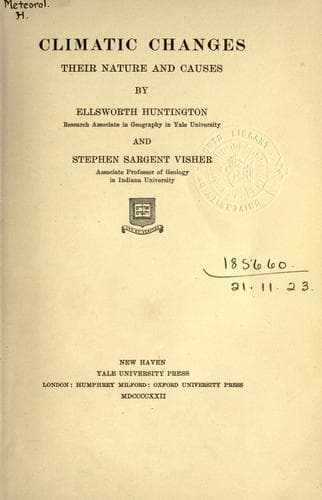
Climatic Changes: Their Nature and Causes — John Shaqi
Climatic Changes: Their Nature and CausesHuntington, Ellsworth
Science
Climatic Changes: Their Nature and Causes
Huntington, Ellsworth
Climatic changes; Climatology; Paleoclimatology
The astonishing quality of the earth's uniformity of temperature becomes
still more apparent when we consider the origin of the sun's heat. What
that origin is still remains a question of dispute. The old ideas of a
burning sun, or of one that is simply losing an original supply of heat
derived from some accident, such as collision with another body, were
long ago abandoned. The impact of a constant supply of meteors affords
an almost equally unsatisfactory explanation. Moulton[8] states that if
the sun were struck by enough meteorites to keep up its heat, the earth
would almost certainly be struck by enough so that it would receive
about half of 1 per cent as much heat from them as from the sun. This is
millions of times more heat than is now received from meteors. If the
sun owes its heat to the impact of larger bodies at longer intervals,
the geological record should show a series of interruptions far more
drastic than is actually the case.
It has also been supposed that the sun owes its heat to contraction. If
a gaseous body contracts it becomes warmer. Finally, however, it must
become so dense that its rate of contraction diminishes and the process
ceases. Under the sun's present condition of size and density a radial
contraction of 120 feet per year would be enough to supply all the
energy now radiated by that body. This seems like a hopeful source of
energy, but Kelvin calculated that twenty million years ago it was
ineffective and ten million years hence it will be equally so. Moreover,
if this is the source of heat, the amount of radiation from the sun
would have to vary enormously. Twenty million years ago the sun would
have extended nearly to the earth's orbit and would have been so tenuous
that it would have emitted no more heat than some of the nebulae in
space. Some millions of years later, when the sun's radius was twice as
great as at present, that body would have emitted only one-fourth as
much heat as now, which would mean that on the earth's surface the
theoretical temperature would have been 200 deg. below the present level.
This is utterly out of accord with the uniformity of climate shown by
the geological record. In the future, if the sun's contraction is the
only source of heat, the sun can supply the present amount for only ten
million years, which would mean a change utterly unlike anything of
which the geological record holds even the faintest hint.[9]
Public-domain text, read in full here on John Shaqi.
Reviews
Reviews
No reviews yet
Be the first to share your thoughts on this work.
Join the Discussion
Join the discussion
Sign in to leave a comment or review.
Sign InorCreate an account