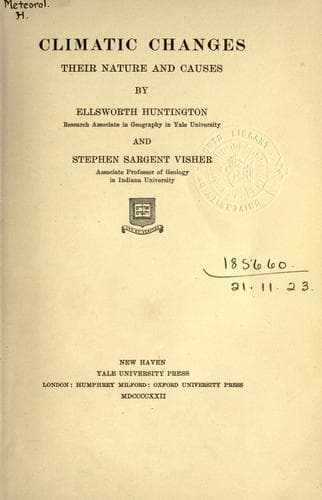
Climatic Changes: Their Nature and CausesHuntington, Ellsworth
Science
Climatic Changes: Their Nature and Causes
Huntington, Ellsworth
Climatic changes; Climatology; Paleoclimatology
In addition to the main effects upon atmospheric circulation and
precipitation, each of the many upheavals of the lands must have been
accompanied by many minor conditions which tended toward diversity. For
example, the streams were rejuvenated, and instead of meandering perhaps
over vast flood plains they intrenched their channels and in many cases
dug deep gorges. The water table was lowered, soil was removed from
considerable areas, the bare rock was exposed, and the type of dominant
vegetation altered in many places. An almost barren ridge may represent
all that remains of what was once a vast forested flood plain. Thus,
increased elevation of the land produces contrasted conditions of slope,
vegetation, availability of ground water, exposure to wind and so forth,
and these unite in diversifying climate. Where mountains are formed,
strong contrasts are sure to occur. The windward slopes may be very
rainy, while neighboring leeward slopes are parched by a dry foehn wind.
At the same time the tops may be snow-covered. Increased local contrasts
in climatic conditions are known to influence the intensity of cyclonic
storms,[91] and these affect the climatic conditions of all middle and
high latitudes, if not of the entire earth. The paths followed by
cyclonic storms are also altered by increased contrast between land and
water. When the continents are notably colder than the neighboring
oceans, high atmospheric pressure develops on the lands and interferes
with the passage of lows, which are therefore either deflected around
the continent or forced to move slowly.
The distribution of lofty mountains has an even more striking climatic
effect than the general uplift of a region. In Proterozoic times there
was a great range in the Lake Superior region; in the late Devonian the
Acadian mountains of New England and the Maritime Provinces of Canada
possibly attained a height equal to the present Rockies. Subsequently,
in the late Paleozoic a significant range stood where the Ouachitas now
are. Accompanying the uplift of each of these ranges, and all others,
the climate of the surrounding area, especially to leeward, must have
been altered greatly. Many extensive salt deposits found now in fairly
humid regions, for example, the Pennsylvanian and Permian deposits of
Kansas and Oklahoma, were probably laid down in times of local aridity
due to the cutting off of moisture-bearing winds by the mountains of
Llanoria in Louisiana and Texas. Hence such deposits do not necessarily
indicate periods of widespread and profound aridity.
Public-domain text, read in full here on John Shaqi.
Reviews
Reviews
No reviews yet
Be the first to share your thoughts on this work.
Elsewhere in the archive
Join the Discussion
Join the discussion
Sign in to leave a comment or review.
Sign InorCreate an account