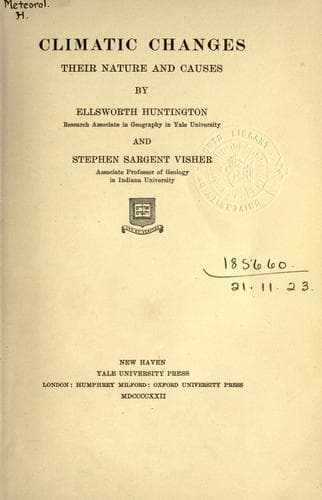
Climatic Changes: Their Nature and CausesHuntington, Ellsworth
Science
Climatic Changes: Their Nature and Causes
Huntington, Ellsworth
Climatic changes; Climatology; Paleoclimatology
When the causes of ancient glaciation were first considered by
geologists, about the middle of the nineteenth century, it was usually
assumed that the glaciated areas had been elevated to great heights, and
thus rendered cold enough to permit the accumulation of glaciers. The
many glaciers occurring in the Alps of central Europe where glaciology
arose doubtless suggested this explanation. However, it is now known
that most of the ancient glaciation was not of the alpine type, and
there is adequate proof that the glacial periods cannot be explained as
due directly and solely to uplift. Nevertheless, upheavals of the lands
are among the most important factors in controlling climate, and
variations in the height of the lands have doubtless assisted in
producing climate oscillations, especially those of long duration.
Moreover, the progressive increase in the height of the lands has
presumably played a part in fostering local and zonal diversity in
contrast with the relative uniformity of earlier geological times.
IV. The contraction of the earth has been accompanied by volcanic
activity as well as by changes in the extent, distribution, and altitude
of the lands. The probable part played by volcanic dust as a
contributory factor in producing short sudden climatic variations has
already been discussed. There is, however, another though probably less
important respect in which volcanic activity may have had at least a
slight climatic significance. The oldest known rocks, those of the
Archean era, contain so much igneous matter that many students have
assumed that they show that the entire earth was once liquid. It is now
considered that they merely indicate igneous activity of great
magnitude. In the later part of Proterozoic time, during the second
quarter of the earth's history according to Schuchert's estimate, there
were again vast outflowings of lava. In the Lake Superior district, for
example, a thickness of more than a mile accumulated over a large area,
and lavas are common in many areas where rocks of this age are known.
The next quarter of the earth's history elapsed without any
correspondingly great outflows so far as is known, though several lesser
ones occurred. Toward the end of the last quarter, and hence quite
recently from the geological standpoint, another period of outflows,
perhaps as noteworthy as that of the Proterozoic, occurred in the
Cretaceous and Tertiary.
Public-domain text, read in full here on John Shaqi.
Reviews
Reviews
No reviews yet
Be the first to share your thoughts on this work.
Elsewhere in the archive
Join the Discussion
Join the discussion
Sign in to leave a comment or review.
Sign InorCreate an account