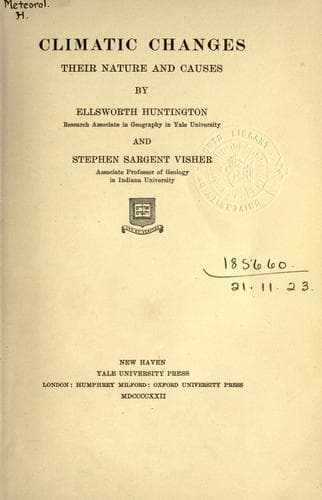
Climatic Changes: Their Nature and CausesHuntington, Ellsworth
Science
Climatic Changes: Their Nature and Causes
Huntington, Ellsworth
Climatic changes; Climatology; Paleoclimatology
At this point Brooks turns to other parts of the world. He states that
not far from 4000 B. C., a submergence of the lands, rarely amounting to
more than twenty-five feet, took place not only in the Baltic region but
in Ireland, Iceland, Spitzbergen, and other parts of the Arctic Ocean,
as well as in the White Sea, Greenland, and the eastern part of North
America. Evidences of a mild climate are found in all those places.
Similar evidence of a mild warm climate is found in East Africa, East
Australia, Tierra del Fuego, and Antarctica. The dates are not
established with certainty but they at least fall in the period
immediately preceding the present epoch. In explanation of these
conditions Brooks assumes a universal change of sea level. He suggests
with some hesitation that this may have been due to one of Pettersson's
periods of maximum "tide-generating force." According to Pettersson the
varying positions of the moon, earth, and sun cause the tides to vary in
cycles of about 9, 90, and 1800 years, though the length of the periods
is not constant. When tides are high there is great movement of ocean
waters and hence a great mixture of the water at different latitudes.
This is supposed to cause an amelioration of climate. The periods of
maximum and minimum tide-generating force are as follows:
Maxima 3500 B. C.--------2100 B. C.--------350 B. C.-------A. D. 1434
Minima ---------2800 B. C.--------1200 B. C.-------A. D. 530---------
Brooks thinks that the big trees in California and the Norse sagas and
Germanic myths indicate a rough agreement of climatic phenomena with
Pettersson's last three dates, while the mild climate of 4000 B. C. may
really belong to 3500 B. C. He gives no evidence confirming Pettersson's
view at the other three dates.
Public-domain text, read in full here on John Shaqi.
Reviews
Reviews
No reviews yet
Be the first to share your thoughts on this work.
Elsewhere in the archive
Join the Discussion
Join the discussion
Sign in to leave a comment or review.
Sign InorCreate an account