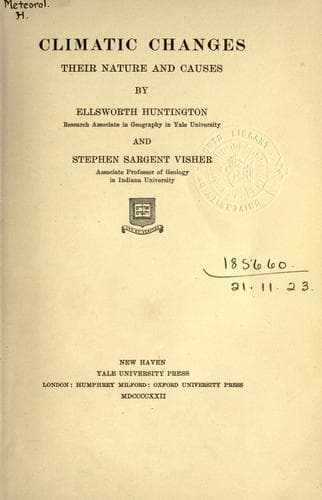
Climatic Changes: Their Nature and CausesHuntington, Ellsworth
Science
Climatic Changes: Their Nature and Causes
Huntington, Ellsworth
Climatic changes; Climatology; Paleoclimatology
To return to Brooks' sketch of the relation of climatic pulsations to
the altitude of the lands, by 3000 B. C., that is, toward the close of
the Neolithic period, further elevation is supposed to have taken place
over the central latitudes of western Europe. Southern Britain, which
had remained constantly above its present level ever since 30,000 B. C.,
was perhaps ninety feet higher than now. Ireland was somewhat enlarged
by elevation, the Straits of Dover were almost closed, and parts of the
present North Sea were land. To these conditions Brooks ascribes the
prevalence of a dry continental climate. The storms shifted northward
once more, the winds were mild, as seems to be proved by remains of
trees in exposed places; and forests replaced fields of peat and heath
in Britain and Germany. The summers were perhaps warmer than now but the
winters were severe. The relatively dry climate prevailed as far west as
Ireland. For example, in Drumkelin Bog in Donegal County a corded oak
road and a two-story log cabin appear to belong to this time. Fourteen
feet of bog lie below the floor and twenty-six above. This period,
perhaps 3000-2000 B. C., was the legendary heroic age of Ireland when
"the vigour of the Irish reached a level not since attained." This, as
Brooks points out, may have been a result of the relatively dry climate,
for today the extreme moisture of Ireland seems to be a distinct
handicap. In Scandinavia, civilization, or at least the stage of
relative progress, was also high at this time.
By 1600 B. C. the land had assumed nearly its present level in the
British Isles and the southern Baltic region, while northern Scandinavia
still stood lower than now. The climate of Britain and Germany was so
humid that there was an extensive formation of peat even on high ground
not before covered. This moist stage seems to have lasted almost to the
time of Christ, and may have been the reason why the Romans described
Britain as peculiarly wet and damp. At this point Brooks again departs
from northwest Europe to a wider field:
It is possible that we have to attribute this damp period in
Northwest Europe to some more general cause, for Ellsworth
Huntington's curves of tree-growth in California and climate in
Western Asia both show moister conditions from about 1000 B. C. to
A. D. 200, and the same author believes that the Mediterranean lands
had a heavier rainfall about 500 B. C. to A. D. 200. It seems that
the phase was marked by a general increase of the storminess of the
temperate regions of the northern hemisphere at least, with a
maximum between Ireland and North Germany, indicating probably that
the Baltic again became the favourite track of depressions from the
Atlantic.
Brooks ends his paper with a brief resume of glacial changes in North
America, but as the means of dating events are unreliable the degree of
synchronism with Europe is not clear. He sums up his conclusions as
follows:
Public-domain text, read in full here on John Shaqi.
Reviews
Reviews
No reviews yet
Be the first to share your thoughts on this work.
Elsewhere in the archive
Join the Discussion
Join the discussion
Sign in to leave a comment or review.
Sign InorCreate an account