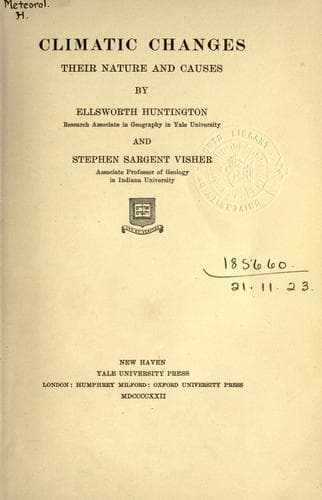
Climatic Changes: Their Nature and CausesHuntington, Ellsworth
Science
Climatic Changes: Their Nature and Causes
Huntington, Ellsworth
Climatic changes; Climatology; Paleoclimatology
On the whole it appears that though there is a general similarity in
the climatic history of the two sides of the North Atlantic, the
changes are not really contemporaneous, and such relationship as
appears is due mainly to the natural similarity in the geographical
history of two regions both recovering from an Ice Age, and only
very partially to world-wide pulsations of climate. Additional
evidence on this head will be available when Baron de Geer publishes
the results of his recent investigations of the seasonal glacial
clays of North America, especially if, as he hopes, he is able to
correlate the banding of these clays with the growth-rings of the
big trees.
When we turn to the northwest of North America, this is brought out
very markedly. For in Yukon and Alaska the Ice Age was a very mild
affair compared with its severity in eastern America and
Scandinavia. As the land had not a heavy ice-load to recover from,
there were no complicated geographical changes. Also, there were no
fluctuations of climate, but simply a gradual passage to present
conditions. The latter circumstance especially seems to show that
the emphasis laid on geographical rather than astronomical factors
of _great_ climatic changes is not misplaced.
Brooks' painstaking discussion of post-glacial climatic changes is of
great value because of the large body of material which he has so
carefully wrought together. His strong belief in the importance of
changes in the level of the lands deserves serious consideration. It is
difficult, however, to accept his final conclusion that such changes are
the main factors in recent climatic changes. It is almost impossible,
for example, to believe that movements of the land could produce almost
the same series of climatic changes in Europe, Central Asia, the western
and eastern parts of North America, and the southern hemisphere. Yet
such changes appear to have occurred during and since the glacial
period. Again there is no evidence whatever that movements of the land
have anything to do with the historic cycles of climate or with the
cycles of weather in our own day, which seem to be the same as glacial
cycles on a small scale. Also, as Dr. Simpson points out in discussing
Brooks' paper, there appears "no solution along these lines of the
problem connected with rich vegetation in both polar circles and the
ice-age which produced the ice-sheet at sea-level in Northern India."
Nevertheless, we may well believe that Brooks is right in holding that
changes in the relative level and relative area of land and sea have had
important local effects. While they are only one of the factors involved
in climatic changes, they are certainly one that must constantly be kept
in mind.
FOOTNOTES:
[Footnote 95: C. E. P. Brooks: The Evolution of Climate in Northwest
Europe. Quart. Jour. Royal Meteorol. Soc., Vol. 47, 1921, pp. 173-194.]
Public-domain text, read in full here on John Shaqi.
Reviews
Reviews
No reviews yet
Be the first to share your thoughts on this work.
Elsewhere in the archive
Join the Discussion
Join the discussion
Sign in to leave a comment or review.
Sign InorCreate an account