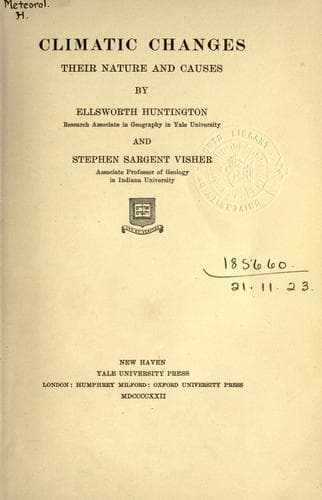
Climatic Changes: Their Nature and CausesHuntington, Ellsworth
Science
Climatic Changes: Their Nature and Causes
Huntington, Ellsworth
Climatic changes; Climatology; Paleoclimatology
[Footnote 96: H. F. Osborn: Men of the Old Stone Age, N. Y., 1915; J. M.
Tyler: The New Stone Age in Northwestern Europe, N. Y., 1920.]
CHAPTER XIII
THE CHANGING COMPOSITION OF OCEANS AND ATMOSPHERE
Having discussed the climatic effect of movements of the earth's crust
during the course of geological time, we are now ready to consider the
corresponding effects due to changes in the movable envelopes--the
oceans and the atmosphere. Variations in the composition of sea water
and of air and in the amount of air must almost certainly have occurred,
and must have produced at least slight climatic consequences. It should
be pointed out at once that such variations appear to be far less
important climatically than do movements of the earth's crust and
changes in the activity of the sun. Moreover, in most cases, they are
not reversible as are the crustal and solar phenomena. Hence, while most
of them appear to have been unimportant so far as climatic oscillations
and fluctuations are concerned, they seemingly have aided in producing
the slight secular progression to which we have so often referred.
There is general agreement among geologists that the ocean has become
increasingly saline throughout the ages. Indeed, calculations of the
rate of accumulation of salt have been a favorite method of arriving at
estimates of the age of the ocean, and hence of the earliest marine
sediments. So far as known, however, no geologist or climatologist has
discussed the probable climatic effects of increased salinity. Yet it
seems clear that an increase in salinity must have a slight effect upon
climate.
Salinity affects climate in four ways: (1) It appreciably influences the
rate of evaporation; (2) it alters the freezing point; (3) it produces
certain indirect effects through changes in the absorption of carbon
dioxide; and (4) it has an effect on oceanic circulation.
(1) According to the experiments of Mazelle and Okada, as reported by
Kruemmel,[97] evaporation from ordinary sea water is from 9 to 30 per
cent less rapid than from fresh water under similar conditions. The
variation from 9 to 30 per cent found in the experiments depends,
perhaps, upon the wind velocity. When salt water is stagnant, rapid
evaporation tends to result in the development of a film of salt on the
top of the water, especially where it is sheltered from the wind. Such a
film necessarily reduces evaporation. Hence the relatively low salinity
of the oceans in the past probably had a tendency to increase the amount
of water vapor in the air. Even a little water vapor augments slightly
the blanketing effect of the air and to that extent diminishes the
diurnal and seasonal range of temperature and the contrast from zone to
zone.
Public-domain text, read in full here on John Shaqi.
Reviews
Reviews
No reviews yet
Be the first to share your thoughts on this work.
Elsewhere in the archive
Join the Discussion
Join the discussion
Sign in to leave a comment or review.
Sign InorCreate an account